
Australia's Migration Overhaul:
Student, Visitor, Working Holiday and Skilled Visas All Move
ELEVEN CHANGES FROM THE 17 SEPTEMBER PRESS CLUB ADDRESS, IN ONE READ
The speech the country waited six weeks for was finally delivered on 17 September.
The same morning, the ABS put net overseas migration at 292,100.
This piece is sorted by visa type, so you can read only the parts that concern you.
On 17 September, Home Affairs Minister Tony Burke set out the next round of migration reform at the National Press Club. Drawing on the speech and the official media release issued that day, the changes touch student visas, graduate visas, visitor visas, working holiday visas, skilled migration and visa compliance. We have organised them into eleven items.
One: net migration and the targets ahead. According to the media release, net overseas migration (NOM) has fallen to about 292,000, down 47% from the post-pandemic peak in 2023. The government intends to hit the Budget figures: 245,000 in 2026-27 and 225,000 in 2027-28. Burke's framing: the housing shortage was not caused by migration, but migration policy must be part of the solution and leave room for housing supply to catch up; at the same time, both city and regional economies need migrant workers, and deep cuts would carry an economic cost.
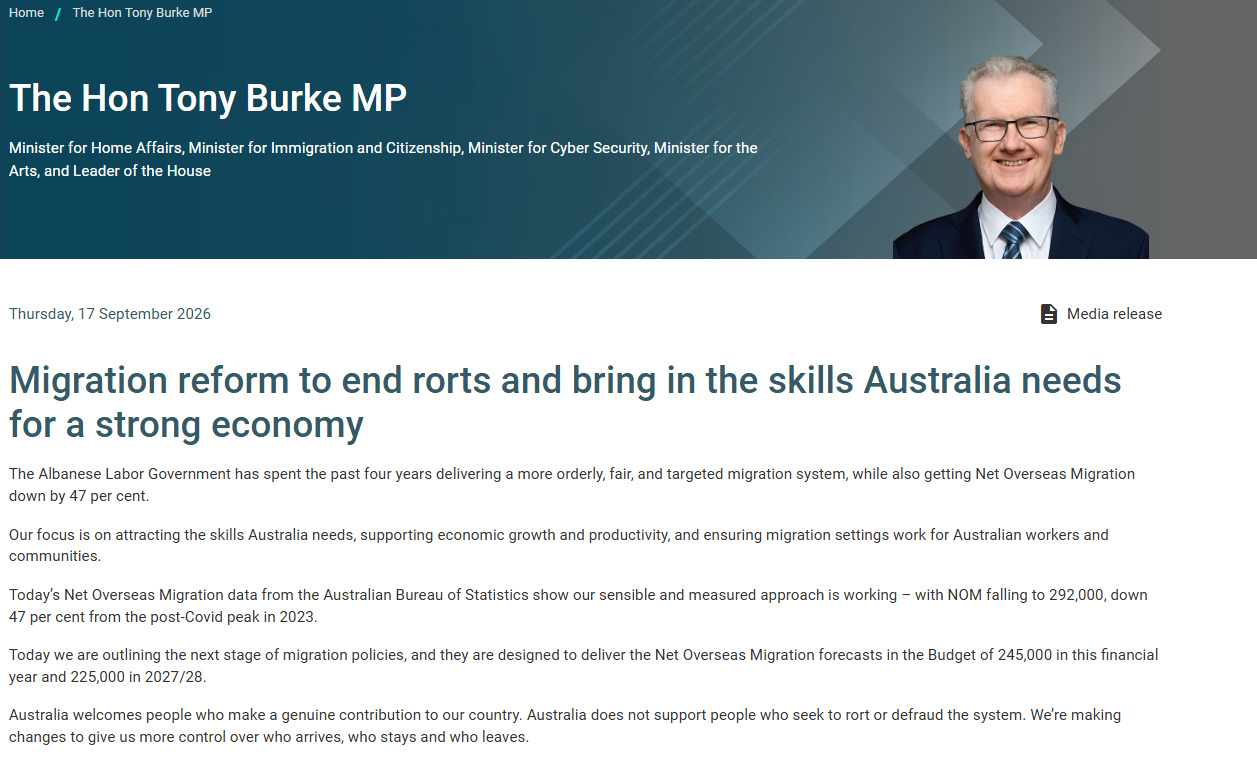
The Minister's media release of 17 September: NOM down 47%, targets of 245,000 and 225,000
Two: the points test, with higher points for housing trades. The government has redesigned the skilled migration points test together with Treasury, focusing on the economic benefit of permanent skilled migrants. The new system will allow higher points for particular skills: on implementation, housing construction trades will receive the same qualification points as a university degree, to attract the workers home-building needs.
Three: an updated Ministerial Direction 119 on processing priority. Burke noted that the current priority rules for temporary and permanent skilled visas are almost identical, which can leave an applicant waiting in both queues at once, and the government will adjust this. The key sectors listed in the media release are: healthcare, construction, education, law enforcement, defence, resources, agriculture, aquaculture and fisheries.
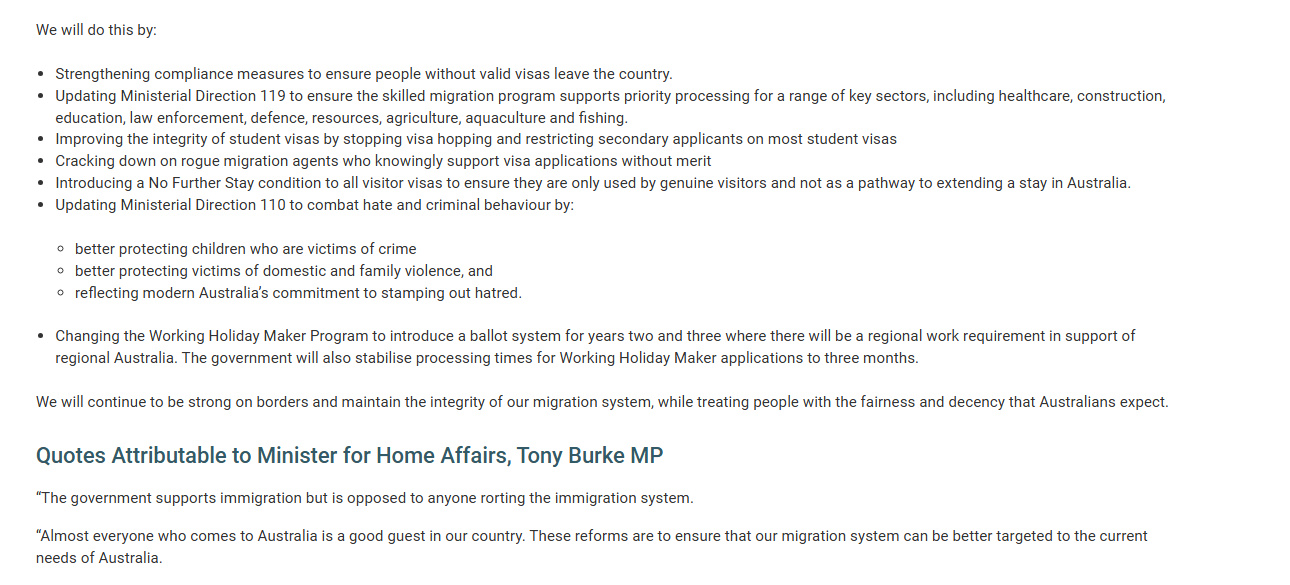
The measures listed in the media release: MD 119 key sectors, student visas, migration agents, visitor visas, MD 110, the working holiday ballot
Four: student and graduate visas, with family members restricted. Most student and graduate visas will no longer allow secondary applicants. For families whose members are already on the visa and already in Australia, Burke was explicit that families will not be broken up. Special arrangements for Pacific and ASEAN countries, and certain courses such as PhDs, will still allow family members.
Five: continuing study, split into extension, course change and progression. Extension: where more time is needed because of serious illness or a provider closing, existing arrangements are unchanged. Course change: switching courses mid-study will require a new visa so the change can be assessed as genuine, and ordinary course changes are not what he means by "visa hopping". Progression: further study after completing a course must move to a higher qualification level, for example a master's after a bachelor's. What the government wants to stop is repeated course switching, especially into providers with lower academic requirements, to extend stay and work rights. Burke also stressed that finishing a course in a shortage area, obtaining a graduate visa, finding related work, securing employer sponsorship and then applying for permanent residence is a normal visa pathway.
Six: working holiday visas, with a ballot for the second and third years. Second-year places will be 45,000, against 57,000 who qualified last year; third-year places will be 5,000, against roughly 31,000. The regional work requirements stay: 88 days for the second year, six months for the third; but completing them now earns only entry into the ballot, not a visa. UK applicants remain exempt from regional work under the relevant free trade agreement. The media release says working holiday processing will be held at three months, though Burke made clear in the speech that UK applicants will for now stay on the slower pace of recent months while other applications return to normal speed.
Seven: visitor visas, with a No Further Stay condition. All visitor visas granted in future will carry a No Further Stay condition, restricting the holder from applying for other visas onshore, with protection visa applications excepted. Burke said this applies only to visas granted in future and does not affect people already in Australia; making the temporary purpose of visitor visas clear should help genuine family visits be approved, and let offshore partners waiting on a partner visa visit regularly.
Eight: protection visas, where further steps need legislation. Burke stressed that Australia must protect genuine asylum seekers, but should deal with applications, appeals and litigation lodged in the knowledge that there is no genuine claim, in order to prolong stay, because they slow down genuine claims. Going further requires legislation, and no complete plan could be announced that day.
Nine: migration agents, with deregistration on the table. The government will amend the migration agents' code of conduct to target agents who support or encourage applications they know lack substance; sanctions will include loss of registration.
Ten: an updated Ministerial Direction 110 to protect victims. The media release also set out the direction of changes to MD 110 to respond to hatred and crime, with a focus on better protecting children who are victims of crime, better protecting victims of family violence, and reflecting Australia's commitment to eliminating hatred.
Eleven: overstayers, with a return to the pre-2015 approach. The process Burke described: a bridging visa with a requirement to depart; those who do not leave are placed in detention, and usually arrange their own flights out within weeks. The government will add 100 compliance officers and 250 detention beds, and is considering a former quarantine facility in Melbourne. He said he does not want simple overstayers held together with people transferred from prison awaiting removal, and stressed that this is not the kind of enforcement seen on television from other countries.
The broader reform still needs legislation. Burke said preparation began last year and the measures were largely settled internally by February. This round is delivered mainly through ministerial directions and regulations. He wants to go further with an Expression of Interest (EOI) mechanism to strengthen control over the demand-driven parts of the system, but that needs legislation, and the government will keep seeking the opposition's cooperation. He also stressed that the government supports migration, and the aim is a system more precisely matched to Australia's current needs.
The plan has landed.
The dates have not.
Until commencement dates and transitional arrangements are published, applications in preparation run on the current rules.

Sun Lawyers · Sydney Office
This article is compiled from Tony Burke's National Press Club address of 17 September and the official media release issued the same day, and is current as at 18 September 2026; full commencement dates and transitional arrangements were not set out in either document, and we will keep tracking them. If your visa plans touch any of the items above and you want to understand how they affect you, contact Sun Lawyers. We work in both English and Mandarin.
Phone: 02 9267 4988 | Email: enquiry@sunlaws.com
Sydney Office: Suite 703 & 704, 265 Castlereagh Street, Sydney NSW 2000
Website: sunlaws.com.au
This article is general legal information only and is not legal advice.
Please contact us for advice specific to your situation.