
Parent Visa 143:
Ten Questions Answered
WHERE THE QUEUE IS, WHAT IT COSTS, AND HOW TO CHOOSE, ON ONE PAGE
Parent visas are the topic we are asked about most,
and the questions are always the same ten.
Here they are, answered against the current official figures.

The visa is what you wait for. This is what you wait for it for | Source: Pexels
01/The queue
Q1 Where is the 143 queue up to?
The Home Affairs queue page (data as at 31 May 2026): contributory parent visas (143, 173, 864, 884) have been released for final processing up to a queue date of November 2018; queue assessment has reached applications lodged in November 2023. Temporary-to-permanent applications (173 to 143 and 884 to 864) have been released up to May 2026. For the non-contributory 103 and 804, release has reached queue dates of March 2014 and April 2014 respectively. The official estimate for a newly lodged application is 15 years for contributory visas and 33 years for the 103 and 804, updated once a year.
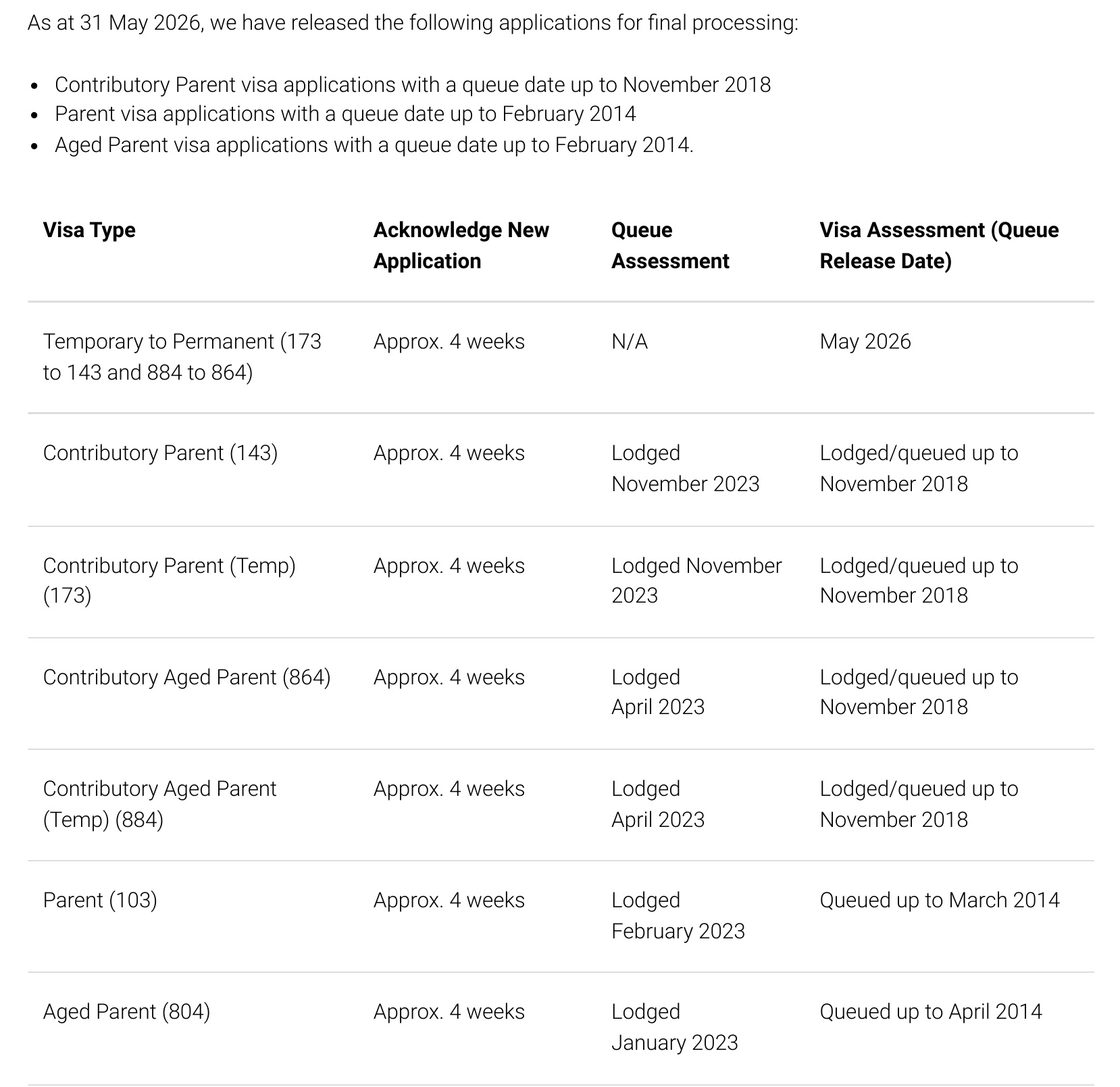
Home Affairs: parent visa processing milestones, data as at 31 May 2026
Q2 What is a queue date, and how do I find my place?
A parent visa application passes through two doors. The first door is getting into the queue: in lodgement order, the department checks each application against the core criteria, such as the sponsor's eligibility and the balance of family test (the official page says health and character are among the core criteria "where applicable"; in practice, health examinations and police certificates are usually requested when the application is released for final processing). If it passes, you receive a letter giving you a "queue date", and from that day you have a place in the line. The second door is getting out of the queue: places are limited each year, and the department releases applications in queue-date order, earliest first, for final assessment and grant.
The two columns in the official table correspond to these two doors. The first is headed "Queue Assessment", and read with the page's explanation that applications are processed in two stages and assessed in lodgement order, it means the assessment for entry to the queue has reached applications lodged in November 2023. The second is headed "Visa Assessment (Queue Release Date)", and matches the page's own sentence that applications with a queue date up to November 2018 have been released for final processing. A further column shows that new applications are acknowledged in about four weeks; that is receipt, not entry to the queue.
How the queue date is set: for 143 applications lodged before 1 June 2018, it is the lodgement date; for later ones, it is the day the department finds the core criteria met, usually some time after lodgement. To find your place, take the queue date from your letter and compare it with the release month in the table, and you can see how many years are still ahead of you. The department does not answer individual status enquiries; it writes to you when your turn comes.
02/The money
Q3 How much does it cost, and in how many instalments?
The official line on the Home Affairs 143 page: from AUD 49,900 for a single applicant, over two instalments. The first is paid at lodgement; the second, which makes up most of the total, is paid after the final assessment and before grant. Costs may be lower for holders of a 173 or a substituted 600 visa, and from 1 July 2026 a concession applies to Pacific Island and Timor-Leste citizens. An accompanying partner is charged separately. These amounts are adjusted periodically (each 1 July); the current figures published by Home Affairs and its pricing estimator govern. Health examinations, police certificates and translations are extra.
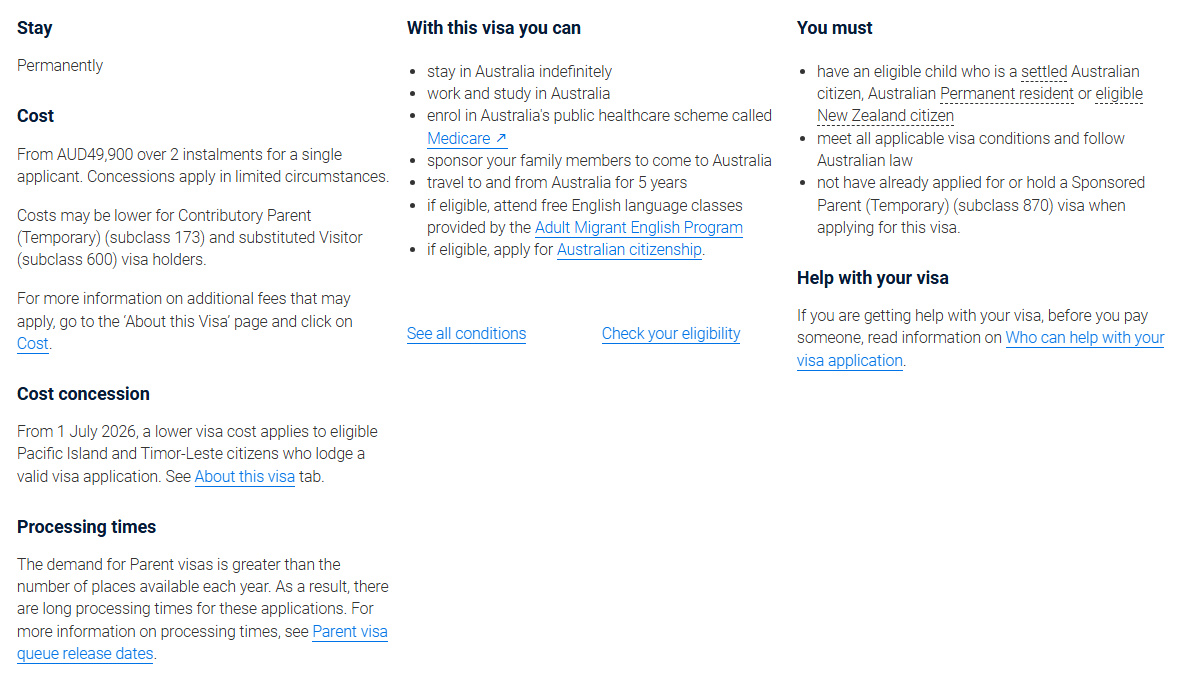
Home Affairs 143 page (updated 24 September 2026): cost, concessions and requirements
Q4 What is the Assurance of Support, who gives it, and for how long?
An AoS is a legal agreement between the assurer and the Commonwealth: the assurer promises that the parent will not rely on recoverable income support during the period, and repays any such payments made. For contributory parent visas the period is 10 years, running from the parent's arrival or the visa grant, whichever is later. The assurer can be a person or an organisation; an individual must be at least 18, an Australian resident and able to prove income for the current and previous financial years, and must pass an income test. If one person's income is not enough, up to two others can join as assurers. Depending on the visa, Services Australia may require a bank guarantee or term deposit through the Commonwealth Bank. Once the visa is granted the assurance cannot be cancelled, not for citizenship, a relationship breakdown or the assurer's financial hardship.
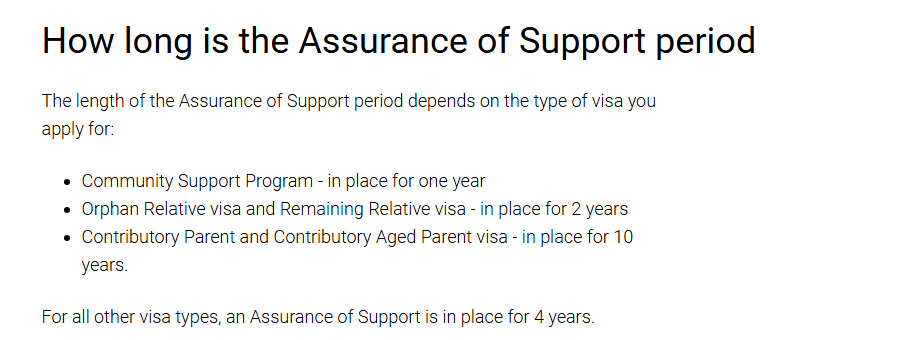
Services Australia: the AoS period for contributory parent visas is 10 years
03/Choosing
Q5 How does the balance of family test work?
It is the threshold test for parent visas, and it looks at where the children live: at least half of the parent's children must be settled in Australia, or more of them must be settled in Australia than live in any other single country. The word that matters is "settled": a child counts as settled in Australia only if they are an Australian citizen, permanent resident or eligible New Zealand citizen, and living in Australia; a child in Australia on a temporary visa, such as a student or work visa, does not count and is treated as living in their usual country of residence. All children count, including step-children. Do the arithmetic before you lodge: if the test is not met, the fee is paid and the application never reaches the queue.
Q6 Parents already in Australia: 864 or 143?
The cost is the same, and release for final processing is at the same point, a queue date of November 2018, though queue assessment is currently a little behind for the 864 (applications lodged to April 2023, against November 2023 for the 143). The official pages differ on two points: the 864 requires the applicant to have reached Australian age pension age, while the 143 has no age requirement; and the 864 is a visa for parents already in Australia to stay, while the 143 is a visa for parents to move to Australia. A parent onshore and old enough usually looks at the 864; one not yet old enough looks at the 143. How the parent's status is managed during the onshore wait varies case by case, and is the part of this choice that most needs professional assessment.
Q7 Can the temporary 870 visa serve as a bridge?
The 870 is temporary: up to 3 or 5 years per visa, a maximum of 10 years in total, costing AUD 6,370 for three years and AUD 12,440 for five, with no work rights, and it requires an approved parent sponsor first, with the application lodged within six months of the sponsorship approval. Its relationship with the permanent parent visas has one hard rule: when you apply for a 143 or 864, you must not already hold, or have applied for, an 870. Sequence therefore matters, and a family that wants both paths should settle the order before lodging anything.
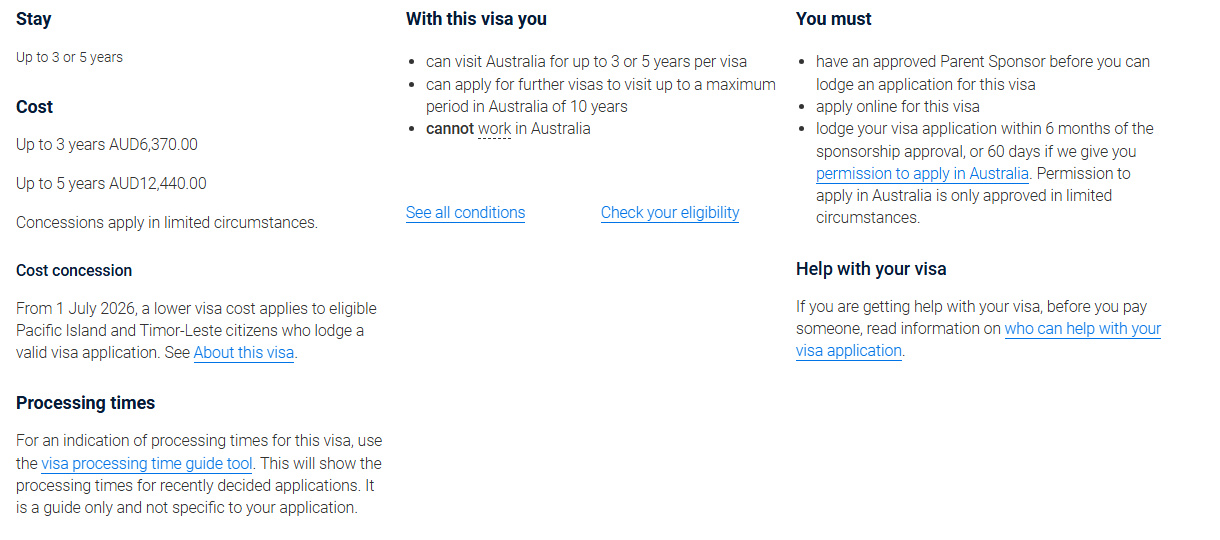
Home Affairs 870 page (updated 24 September 2026): cost and conditions
Q8 Can parents visit during the years in the queue?
Yes. Genuine visits on a visitor visa while a parent visa is queued have always been routine. As we wrote recently, the new round of migration reform will attach a condition to visitor visas granted in future that bars onshore applications for other visas; that affects switching after arrival, not visiting itself. A parent who comes to visit and leaves on time is unaffected.
Q9 Circumstances change over such a long wait. What then?
The official process chart is explicit: when an application is released from the queue, the department assesses it again. When your turn comes, health, character, the sponsor's eligibility and the AoS all have to be dealt with, some for the first time and some checked again; passing at lodgement does not settle them for good. Changes over the years to the sponsoring child's status, the parent's marital circumstances or the spread of the children should be notified and assessed early, and how each is handled depends on the individual case.
Q10 Has the 143 slowed down since Direction 117?
As we wrote in August, Direction 117 adjusts processing priority, giving precedence to onshore applications; it does not change the queue mechanism itself. The way to judge whether things have slowed is not the rumour mill but the release month on the official queue page, which the department updates whenever new processing dates are available. It is a page worth bookmarking.
A queue more than a decade long
starts on the day you lodge.
Get the arithmetic right first, then get the order right.

Sun Lawyers · Sydney Office
The figures in this article are current as at 25 September 2026 and are taken from the current Home Affairs and Services Australia pages; queue dates, charges and estimated waits are updated periodically, and the official pages govern. If you are planning a visa path for your parents, working out the balance of family test, settling the order of an 870 and a 143, or arranging an onshore wait, contact Sun Lawyers. We work in both English and Mandarin.
Phone: 02 9267 4988 | Email: enquiry@sunlaws.com
Sydney Office: Suite 703 & 704, 265 Castlereagh Street, Sydney NSW 2000
Website: sunlaws.com.au
This article is general legal information only and is not legal advice.
Please contact us for advice specific to your situation.