
Student Visa Rules Changed on 2 October:
Renewing, Bringing Family, Switching Visas
APPLIES TO APPLICATIONS LODGED FROM 2 OCTOBER 2026. EARLIER LODGEMENTS KEEP THE OLD RULES
The first regulations from the 17 September overhaul are in force.
They do not change how hard a student visa is to get.
They change where you lodge, whether family can come, and which visas cannot switch from inside Australia.
Under the new rules, many applications start with a flight out | Source: Pexels
01/What the new rules cover
Three things first. One: the Regulations were registered on 1 October 2026 and commenced on 2 October. They apply only to Student (subclass 500) and Student Guardian (subclass 590) applications lodged on or after 2 October. Two: anything lodged before 2 October, including applications with family members, is assessed under the rules that applied when it was lodged. A student visa you already hold is not affected. Three: these are rules about whether an application is validly made, not about whether it is granted. Lodge in Australia when the rules say you cannot, and the application is invalid; the Department does not consider it. Home Affairs spells out the consequence: it may affect your visa status, and if your visa has already expired you may not be eligible to apply for another.
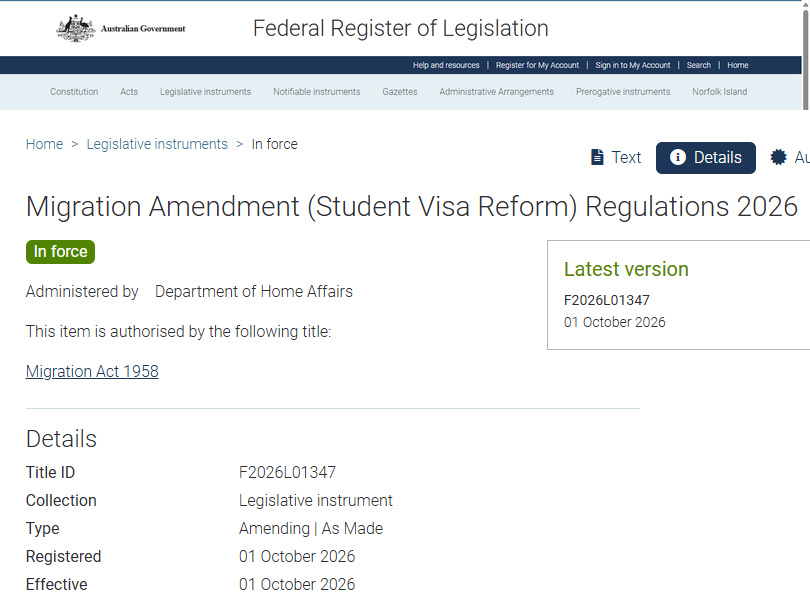
Federal Register of Legislation: Migration Amendment (Student Visa Reform) Regulations 2026, registered 1 October 2026, status In force
02/Renewing: a student visa holder applying for another must, as a rule, apply from offshore
The core rule in one sentence: if you hold a student visa and apply for another one as the primary applicant, you must be outside Australia when you lodge. Outside when you lodge, and outside when it is granted. An offshore application comes with no bridging visa; you can come back on another valid visa while it is processed, but at the moment of grant you must be out of the country.
Home Affairs lists the people who can still lodge in Australia: PhD students; primary and secondary school students; students sponsored by DFAT or Defence; students who need up to 12 more months after their original course end date to finish with the same provider (for a packaged course, the course that needs the extra time must be the main one); students whose provider has defaulted or been sanctioned; and students moving up, that is, who have completed their main course and are moving to a higher AQF level. If the completed course was higher education, the next one must also be higher education with a higher education provider. School leavers moving to a course without an AQF level, and students moving from a course without an AQF level to one with an AQF level, also count as moving up.
In plain terms: moving up is generally fine, with the same provider or a new one; a second course at the same level, or a lower one, means lodging from offshore. The question our last piece left open, whether a second master's counts as moving up, now has an answer: it does not. Two things people miss. A dependant on a student visa who now wants to apply as the primary applicant is caught by the same rule, and on the wording of the Regulations the exemption list above is for people who hold their visa as the primary applicant. And the old route of lodging in Australia within 28 days of a student visa expiring is gone. The official reason is blunt: it was removed so that nobody can get around the offshore rule by waiting for their visa to expire and then lodging.
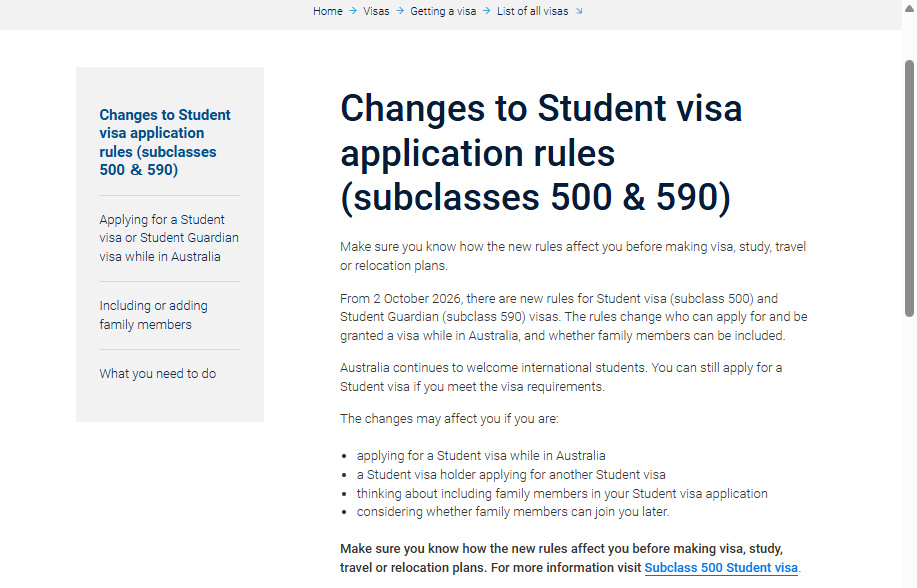
Department of Home Affairs: new application rules for Student and Student Guardian visas from 2 October 2026
03/Family: new applications generally cannot include them, and none can be added later
A student visa application lodged from 2 October generally cannot include a partner or children, and that includes further student visa applications. There are four exemptions: PhD students; students sponsored by DFAT or Defence; students fully funded by a foreign government scholarship; and eligible students from Pacific countries and ASEAN member countries. China is in neither group, so for Chinese students the realistic routes are a PhD or a full government scholarship.
For a student visa that has already been granted, adding family later is closed altogether. Home Affairs' own words: there are no exemptions to this rule.
If family members are already on your current student visa, there are two situations. If you lodge your next student visa in Australia, Home Affairs says you "may be able to" include them. If what you need is up to 12 more months with the same provider to finish your main course, or a new visa because your provider defaulted, Home Affairs says you may also be able to include them whether you lodge in or outside Australia. Two hard conditions apply either way: the primary applicant and every family member must be in the same place when the application is lodged, and if you include a family member who is not eligible, that person's application is invalid. One category is in the Regulations but not on the website: a child born in Australia after commencement to a parent who held a student visa at commencement can apply as a family member.
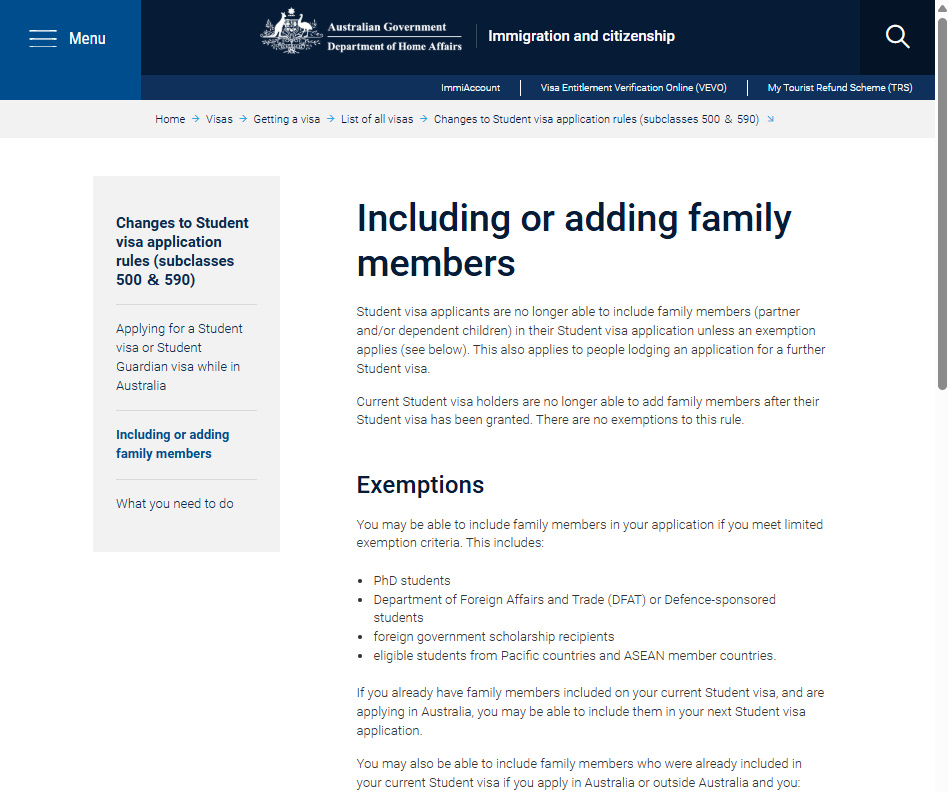
Home Affairs family members page: family cannot be added to a granted student visa, with no exemptions
04/Switching: holders of 17 visas cannot lodge a student visa in Australia
A ministerial instrument made alongside the Regulations, LIN 26/102, lists 17 visa entries whose holders cannot lodge a Student or Student Guardian application in Australia; they must apply from offshore. Nine were already on the list, the visitor visas and the 485 since July 2024: Visitor 600, 601 and 651, Temporary Graduate 485, Medical Treatment 602, Transit 771, Maritime Crew 988, Diplomatic 995, and the Domestic Worker stream of the 403. Eight entries are new: 400, 407, 408, 417, 457, 462, and both versions of the 482. For Chinese readers the two that matter are the 462 Work and Holiday and the 482 employer sponsored visas.
This is not a ban on switching. It is a ban on switching from inside Australia: lodge offshore, wait offshore, no bridging visa, the same as renewing above. The list also applies to the 590 Student Guardian visa, although Home Affairs says a current 590 holder applying for a further 590 can still lodge in Australia.
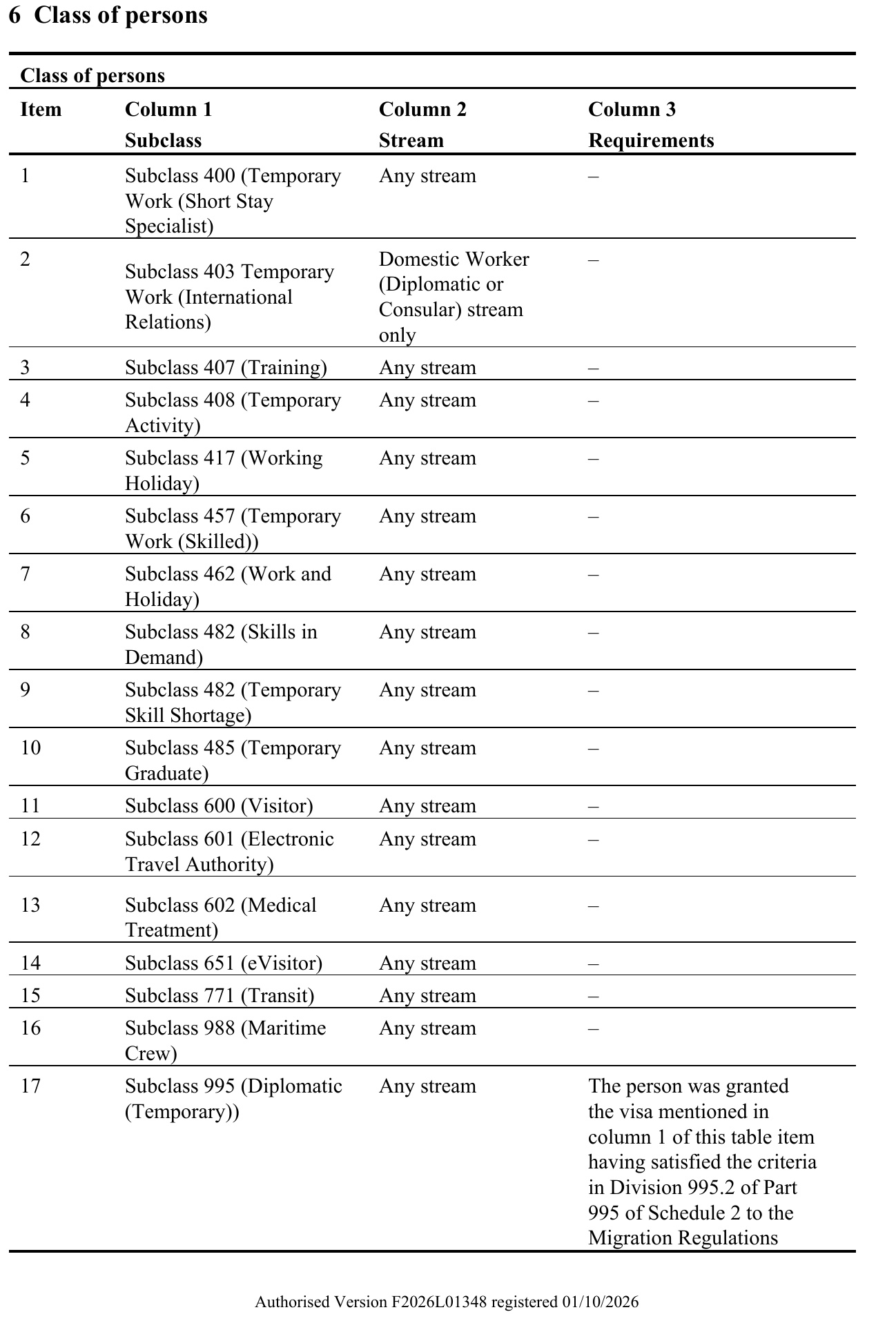
LIN 26/102, section 6: holders of 17 visa subclasses must lodge student visa applications from outside Australia (Federal Register F2026L01348)
A word on what has not landed. The working holiday ballot for second and third year visas, and the no further stay condition on visitor visas, had no commencement document on the Federal Register or the Home Affairs website as at 8 October; they remain announcements. The method from our last piece has not changed: it is in force when you see the document. These student visa regulations are the example, one day from registration to commencement.
The new rules change where you lodge, not where you are going.
But an application lodged in the wrong place
is never considered at all.

Sun Lawyers · Sydney Office
This article is current as at 8 October 2026; the Federal Register of Legislation and the Department of Home Affairs website are the authoritative sources. If you hold a student visa and are about to renew, bring family, or move to a student visa from another visa, and want to confirm where you must lodge and who you can include before you do, contact Sun Lawyers. We work in both English and Mandarin.
Phone: 02 9267 4988 | Email: enquiry@sunlaws.com
Sydney Office: Suite 703 & 704, 265 Castlereagh Street, Sydney NSW 2000
Website: sunlaws.com.au
This article is general legal information only and is not legal advice.
Please contact us for advice specific to your situation.