
The Bankruptcy Reforms We Were Promised,
Two Years On
WHERE THE 28 DAYS AND THE $20,000 THRESHOLD HAVE GOT TO
Updated September 2026: Treasury's consultation has closed — the reform bill is yet to appear.
In July 2024, the federal government announced four bankruptcy reforms.
Two years on, 21 days is still 21 days, and $10,000 is still $10,000.
Here is what was promised, where it stalled, and what to plan around now.

Two years on, the hands have not moved | Source: Pexels
01/What was promised
On 8 July 2024, the then Attorney-General Mark Dreyfus announced that the government would amend the Bankruptcy Act 1966 (Cth) to make the system "fairer" and reduce the stigma of bankruptcy. Four changes sat at the core:

The Attorney-General's media release, 8 July 2024: the four reforms
THE FOUR PROMISED REFORMS
Involuntary bankruptcy threshold: $10,000 up to $20,000, indexed annually
Time to respond to a bankruptcy notice: 21 days up to 28 days
NPII listing of a discharged bankruptcy: cut to 7 years after discharge (currently permanent)
Proposing or accepting a debt agreement: no longer an act of bankruptcy under s 40(1)
The same day, public consultation opened on a Minimal Asset Procedure: a lighter alternative to bankruptcy for debtors with almost no realisable assets and debts under $50,000, proposed to run for 12 months, stay on the NPII for 4 years after discharge, and be available once in a lifetime. That consultation closed on 29 July 2024.
02/Two years on: where it stalled
And then? Then came a long quiet. The first real change happened not in the statute but inside the machinery: in May 2025, bankruptcy policy was transferred wholesale from the Attorney-General's Department to Treasury. The department changed. The reform papers stayed the same papers.

Treasury's consultation page: policy functions transferred to Treasury in May 2025; the consultation itself closed back in July 2024
As at 21 August 2026, we have found no bill and no exposure draft implementing any of the four reforms. On the Bankruptcy Act's amendment record, the most recent bankruptcy-specific amendment remains the 2023 technical Act on calculating discharge dates. The AFSA and Federal Court pages still say 21 days and $10,000. An announcement is not a commencement: the current rules remain the only rules in force.
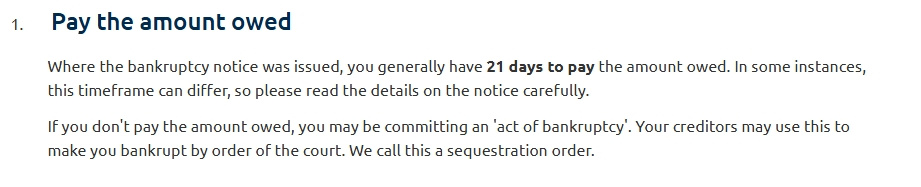
AFSA's current page: the response period is still generally 21 days
As for the bigger ideas, such as cutting the default bankruptcy period from 3 years to 1, they were contested at the original roundtable and ended up listed only as a "long-term reform priority", with no timetable to this day.
03/What to plan around now
If you are a creditor: the current rules are the usable rules. A final judgment of $10,000 or more can still go down the bankruptcy notice path today. Once the reform lands and the threshold moves to $20,000, judgment debts between $10,000 and $20,000 will lose that path and depend on ordinary enforcement instead. Nobody knows when that door closes; it is open now.
If you are a debtor: if a bankruptcy notice arrives, work to the deadline printed on it, which today is still generally 21 days. Do not bet on the 28 days arriving early. Likewise, "proposing a debt agreement will no longer be an act of bankruptcy" is, for now, only a promise: until the reform commences, lodging a Part IX proposal remains an act of bankruptcy in law, with the consequences we covered in our last piece on the two roads besides bankruptcy.
We are watching Treasury. The moment an exposure draft or a bill appears, we will break it down.
Reforms live in media releases.
Rules live in the statute.
Make your decisions on the latter.

Sun Lawyers · Sydney Office
This article is current as at 21 August 2026. If you are weighing up debt recovery options, or choosing between bankruptcy and its alternatives and want to know where you stand under the rules as they are, contact Sun Lawyers. We work in both English and Mandarin.
Phone: 02 9267 4988 | Email: enquiry@sunlaws.com
Sydney Office: Suite 703 & 704, 265 Castlereagh Street, Sydney NSW 2000
Website: sunlaws.com.au
This article is general legal information only and is not legal advice.
Please contact us for advice specific to your situation.