
The Non-Compete Ban We Were Promised:
Where It's Got To
A 2027 PROMISE, AND THE CLAUSE SITTING IN YOUR CONTRACT TODAY
In March 2025 the federal Budget announced that, from 2027, non-compete clauses would be banned for most employees.
Eighteen months on, the consultation is done and there is still no bill.
Here is what was promised, where it stalled, and how to write contracts now.

For now, the freedom to leave is still written in the Budget | Source: Pexels
01/What was promised
In the 2025-26 Budget of March 2025, the government announced three reforms aimed at labour mobility. First, amend the Fair Work Act 2009 (Cth) to ban post-employment non-compete clauses for employees earning below the "high income threshold". Second, ban "no-poach" agreements between businesses. Third, ban wage-fixing agreements between businesses. The official line: effective from 2027, following the passage of legislation, and operating prospectively.
That high income threshold moves every 1 July. As at September 2026 it is $190,100 (for 2026-27); it was $183,100 the year before, and $175,000 when the ban was announced. The amount is adjusted periodically (each 1 July), and the latest figure published by Fair Work governs. In other words, employees whose "earnings", as that term is defined in the Fair Work Act, fall below that line, which is the large majority, are within the range of the proposed ban.
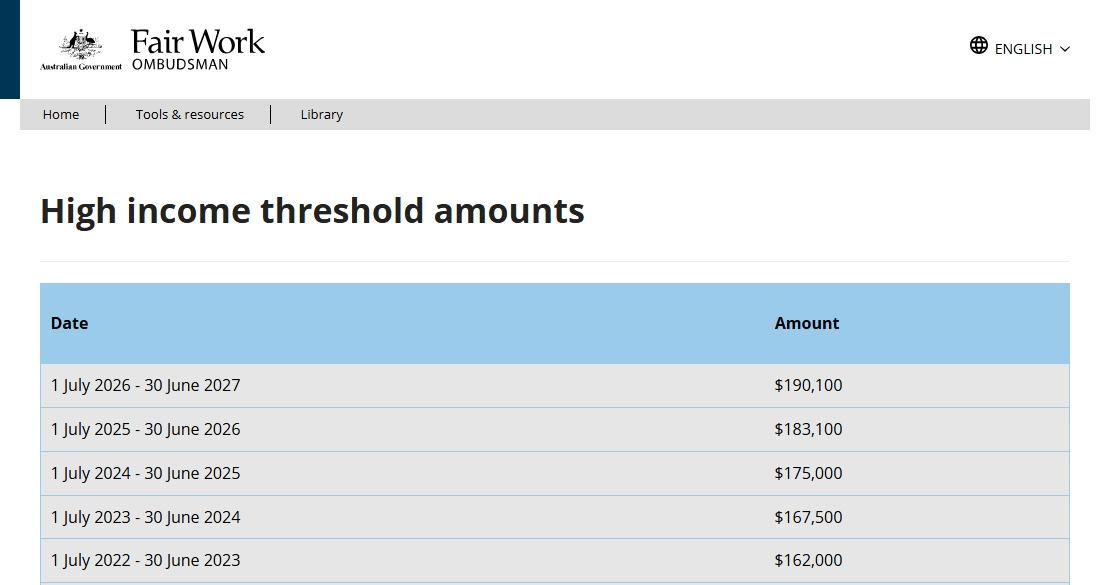
Fair Work Ombudsman: the high income threshold by year, $190,100 for 2026-27
The consultation paper also drew boundaries: restraints attached to the sale of a business are outside the reform, with the government stating it is "not proposing changes to restraints of trade outside of employment"; confidentiality and intellectual property clauses are not the target either.
02/Where it has got to
The timeline first:
TIMELINE
August 2023 Federal Competition Review begins
April 2024 Treasury issues paper, first round of consultation
March 2025 Budget announces the ban, targeting 2027
25 July to 5 September 2025 Consultation on policy details; 67 submissions
As at 4 September 2026 No exposure draft. No bill.
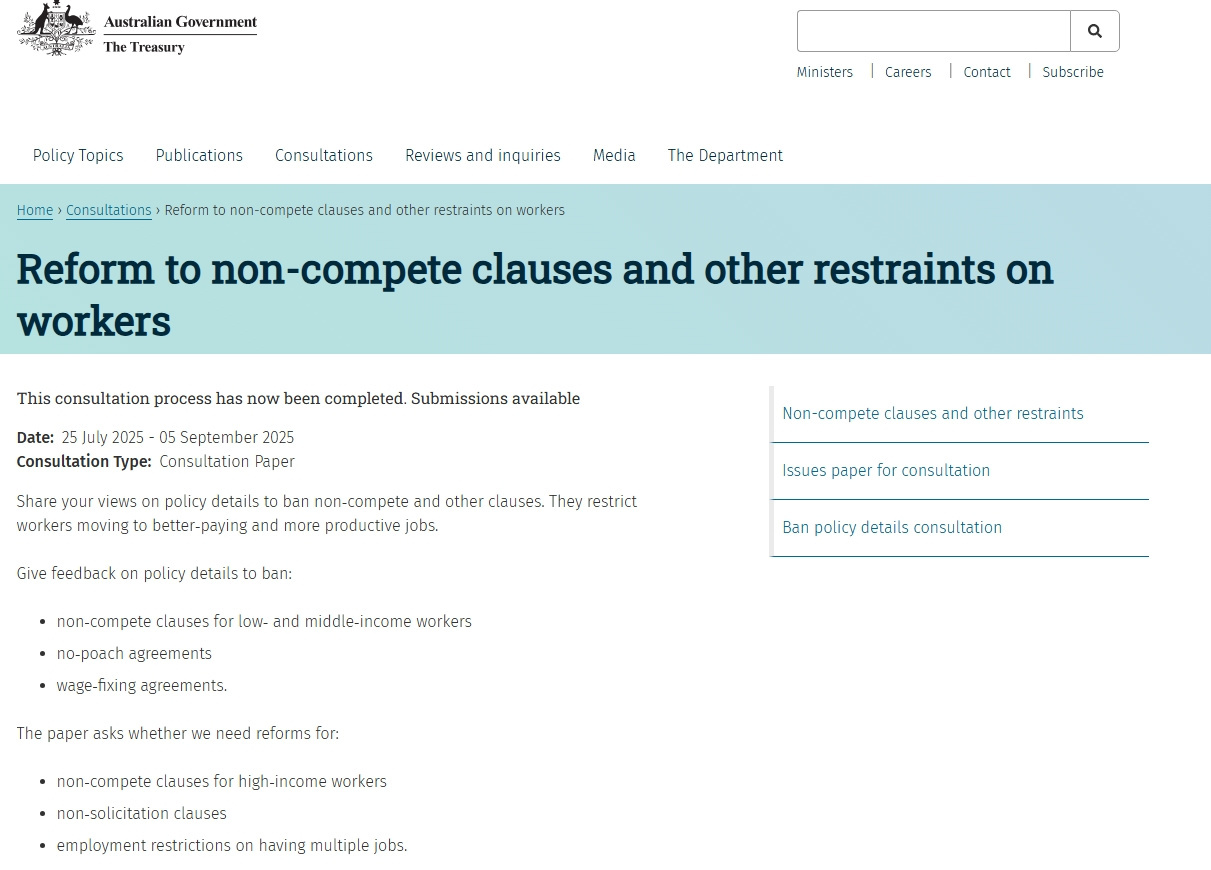
Treasury's consultation page: closed on 5 September 2025, 67 submissions received
The consultation paper left four questions open, and the answers will decide how much bite the ban really has. One: does the ban cover only contracts made or varied after commencement, or does it void existing contracts too? The paper's working assumption is the former, but the government has said it is considering feedback on existing contracts. Two: should there be any exceptions below the threshold? Three: should high earners above the threshold be restricted as well, with options including mandatory compensation or a statutory cap on duration? Four: should non-solicitation clauses (no taking clients, no poaching colleagues) be restricted too, and should the ban extend to independent contractors whose position resembles an employee's?
The present state of play: a year after consultation closed, the official position remains "from 2027, subject to legislation passing". 2027 is a target, not a promise; until a bill passes, the legal status of the non-compete clause in your contract has not changed by a single word.
03/What to plan around now
If you are an employer: first, dispel a myth. Under the current law, a non-compete clause is not valid simply because it was signed. The common law presumes a post-employment non-compete to be a restraint of trade and void in principle, unless the employer can show that its duration, geography and scope go no further than necessary to protect a legitimate business interest; and in NSW, the Restraints of Trade Act 1976 (NSW) lets a court read an over-broad clause down to a reasonable one and enforce that. So the real guardrails were never the non-compete itself. They are confidentiality clauses, intellectual property clauses, non-solicitation clauses, notice periods and garden leave, and under this reform those are either untouched or merely "under discussion". Get them solid now, and assess key employees above the threshold separately.
If you are an employee: until the ban commences, your existing contract binds you as before, and "it's going to be banned anyway" is no shield for leaving early. When you sign a new contract, though, this clause is now a legitimate item on the negotiating table.
We are watching Treasury. The moment an exposure draft or a bill appears, we will break it down.
The clause is still in the contract.
The ban is still in the Budget.
What decides between them, always, is the law as it stands.

Sun Lawyers · Sydney Office
This article is current as at 4 September 2026. If you are an employer wanting to review the restraints in your contracts before the reform lands, or an employee whose next move is held up by a non-compete clause, contact Sun Lawyers. We work in both English and Mandarin.
Phone: 02 9267 4988 | Email: enquiry@sunlaws.com
Sydney Office: Suite 703 & 704, 265 Castlereagh Street, Sydney NSW 2000
Website: sunlaws.com.au
This article is general legal information only and is not legal advice.
Please contact us for advice specific to your situation.