
Trapped by a Lease as Well?
NSW's New Rules Start 21 September
TENANTS CAN LEAVE MORE SAFELY, AND LANDLORDS AND AGENTS TAKE ON A NEW 7-DAY DUTY
For many people leaving a dangerous relationship,
the most practical obstacle is not resolve. It is the lease that has not expired.
From 21 September, the rules in NSW stand with the person leaving.

A new set of keys is where safety begins | Source: Pexels
NSW Fair Trading has recently updated its rental reform timeline: the Residential Tenancies Amendment (Domestic Violence Reform) Act 2025 (NSW) and its supporting regulation will commence on 21 September 2026, delivering a systematic upgrade of the existing domestic violence protections in the rental market.
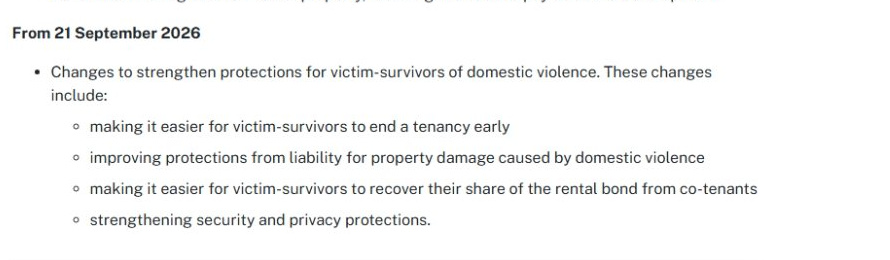
NSW Fair Trading: the reform timeline, showing the changes commencing 21 September 2026
Whether you are a tenant, a landlord, an agent, or sharing a rental with others, these changes concern you.
01/The rights that already exist
Start with the current rules: in NSW, a victim-survivor of domestic violence can already end their own tenancy immediately by giving a domestic violence termination notice, without penalty for breaking the lease early. The notice must be accompanied by prescribed evidence, such as a relevant court order or apprehended violence order (AVO), or a declaration made by a "competent person" such as a doctor.
In practice, though, this pathway has had its deterrents: after leaving, the victim-survivor has had to notify the remaining co-tenants themselves; the range of people who can make a competent person declaration has been limited; and the bond, and liability for property damage, have often ended up in a tangle. The reforms commencing 21 September are aimed squarely at those blockages.
02/Seven changes from 21 September
Leaving becomes easier. First, once a domestic violence termination notice is given, the responsibility for notifying the remaining co-tenants shifts from the victim-survivor to the landlord or agent, who must do so within 7 days. The person leaving no longer carries the risk of being the one to break the news. Second, the rules on who can make a competent person declaration are clarified and expanded, adding a category of prescribed employees. The government's stated purpose: better access to this evidence for people with disability, Aboriginal and Torres Strait Islander people, migrants, refugees, people with limited English, and people in rural and remote areas.
Liability becomes clearer. Third, where the Tribunal determines that property damage was caused by domestic abuse, the victim-survivor and other co-tenants who are not the alleged perpetrator are not liable for it. Fourth, there is now a clear pathway for the bond: the Tribunal can order a remaining co-tenant to pay a departing victim-survivor an amount equal to their bond entitlement, divided according to each person's contribution, or in equal shares where there is no evidence of individual contributions.
Privacy becomes safer. Fifth, landlords and agents must give 7 days' notice before taking photos or video for advertising, and where a tenant's possessions are visible, must obtain written consent before publication; a tenant can withhold consent with evidence of domestic abuse, or a reasonable fear that publication could reveal their location. Sixth, the grounds for changing locks without the landlord's consent expand, including where the alleged perpetrator is legally barred from the property by an apprehended violence order, domestic violence order, family violence injunction, bail condition or parole condition. Seventh, listing a victim-survivor on a tenancy database is banned where the tenant can provide evidence of domestic abuse during the tenancy, and NSW Fair Trading can order a database operator to remove a prohibited listing.
03/What it means for you
If you are in this situation now: the existing domestic violence termination pathway is available today, without waiting for 21 September; once the new rules commence, the process of leaving will carry less exposure and less entanglement. Preparing the evidence, giving the notice, and settling accounts with the other tenants are the parts of this road where professional help matters most. You do not have to work it out alone.
If you are a landlord or agent: three items for the compliance list. Notifying the remaining co-tenants within 7 days of receiving a domestic violence termination notice is now your duty; the notice-and-consent process for advertising photos needs updating; and listing a victim-survivor on a tenancy database becomes expressly prohibited. Remember too: where the Tribunal determines damage was caused by domestic abuse, it cannot be recovered from the victim-survivor or from co-tenants who are not the alleged perpetrator.
If you are a co-tenant: when someone leaves because of domestic violence, the lease and the bond are no longer a muddle. The Tribunal can determine each person's share of the bond directly, which gives both those who stay and those who leave a place to be heard.
The law cannot undo what has happened.
It can make the road out shorter, and safer.
From 21 September, that road gets a little smoother.
If you or someone you know is in immediate danger, call 000.
1800RESPECT (1800 737 732) provides free, confidential counselling 24/7.

Sun Lawyers · Sydney Office
This article is current as at 28 August 2026. If you are considering ending a tenancy through a domestic violence termination notice, or you are a landlord or agent working out your obligations under the new rules, contact Sun Lawyers. We work in both English and Mandarin.
Phone: 02 9267 4988 | Email: enquiry@sunlaws.com
Sydney Office: Suite 703 & 704, 265 Castlereagh Street, Sydney NSW 2000
Website: sunlaws.com.au
This article is general legal information only and is not legal advice.
Please contact us for advice specific to your situation.