
The Non-Compete Ban Has a Draft Bill:
Void Under $190,100, and Illegal Just to Write One In
OUR LAST PIECE SAID THERE WAS NO BILL IN SIGHT. THREE DAYS LATER, THE DRAFT ARRIVED
On 7 September Treasury released the exposure draft. Consultation closed on 2 October.
The four open questions from our last piece now have answers.
If you run a salon, a restaurant or an agency, this is what to change in your staff contracts.

Skills leave with the person, and clients follow the skills | Source: Pexels
01/Four hard rules in the draft
One: non-compete terms are void for employees earning at or below the high income threshold. The threshold is $190,100 for 2026-27, measured as annualised full-time earnings; casuals and pieceworkers are protected whatever they earn. The sentence that matters: putting a non-compete term in the contract is itself a breach. You do not have to enforce it to be caught. The term is void, the rest of the contract stands. The penalty is 60 penalty units per breach, 600 for a serious one, five times that for a company. At the current $364 a unit, that is up to $21,840 or $218,400 for an individual and $109,200 or $1.09 million for a company. Threatening a departing employee with a term that has already lost effect is a separate penalty.
Two: clauses stopping an employee from recruiting co-workers are void for everyone, regardless of income. "Co-worker" is drawn wide: contractors, labour hire workers, apprentices and volunteers all count, and so do former co-workers.
Three: only employees above the threshold can be given a non-compete at all, and even then it must clear three tests, which apply to every post-employment restraint, including a client non-solicitation clause for any employee. First, it must be necessary to protect confidential information or client relationships; the draft says in terms that keeping a stable workforce is not a legitimate interest. Second, it must be reasonable and go no further than necessary. Third, no cascading alternatives, such as "12 months, or failing that six"; a clause written that way is void in its entirety, and no court will trim it back to something reasonable.
Four: agreements between businesses not to hire each other's staff, or to fix wages, become cartel conduct, with civil and criminal penalties. A unilateral decision not to hire from a competitor is not caught; an understanding between two or more businesses is.
The draft also lists what it leaves alone: confidentiality terms (unless so wide they stop the person working at all), retention payments, reasonable notice periods and paid garden leave, restraints in a sale of business, and shareholder agreements.
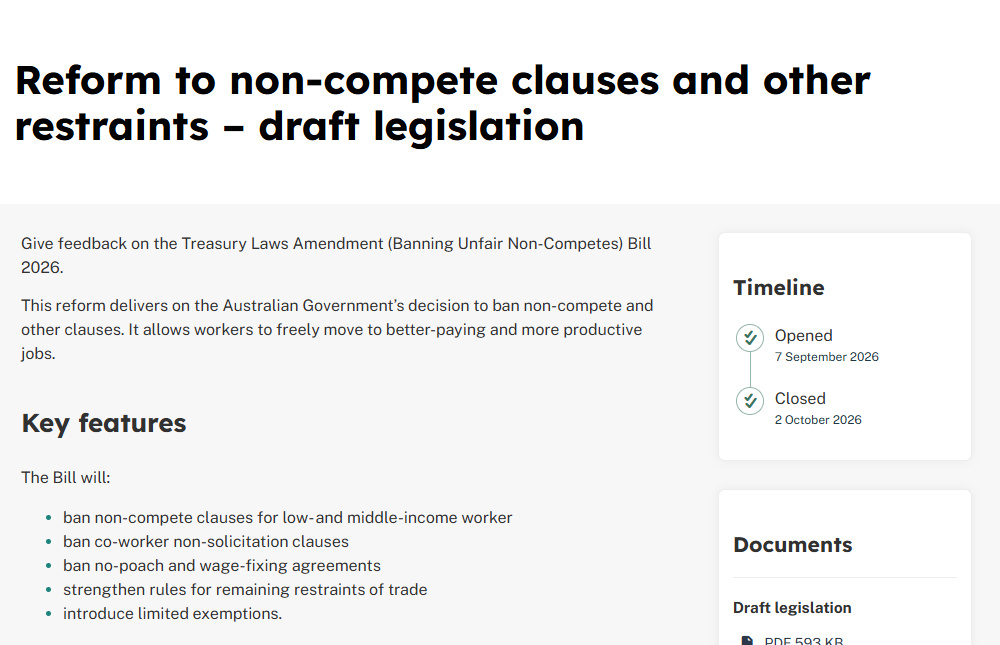
Treasury consultation page: Reform to non-compete clauses and other restraints, opened 7 September 2026, closed 2 October 2026
02/The four open questions, answered
First, existing contracts. A term in a contract signed before commencement keeps operating unless the contract is later varied; once varied, the old term is treated under the new rules. So re-signing contracts or issuing written pay rises after commencement can bring an old clause into the new regime.
Second, exceptions below the threshold. Essentially none, apart from defence, national security and parts of the public sector.
Third, employees above the threshold. Restraints remain possible, limited to confidential information and client relationships, reasonable, and never cascading.
Fourth, client non-solicitation and contractors. Co-worker non-solicitation is banned for everyone, as above. Client non-solicitation terms are not separately banned; on the text, they appear to survive at any income level, provided they are necessary to protect client relationships and reasonable. A clause drawn so wide that it effectively stops the person working in the industry will be treated as a non-compete. Whether independent contractors who work like employees are themselves protected is not something we could find in the draft; that will be settled by the final Bill.
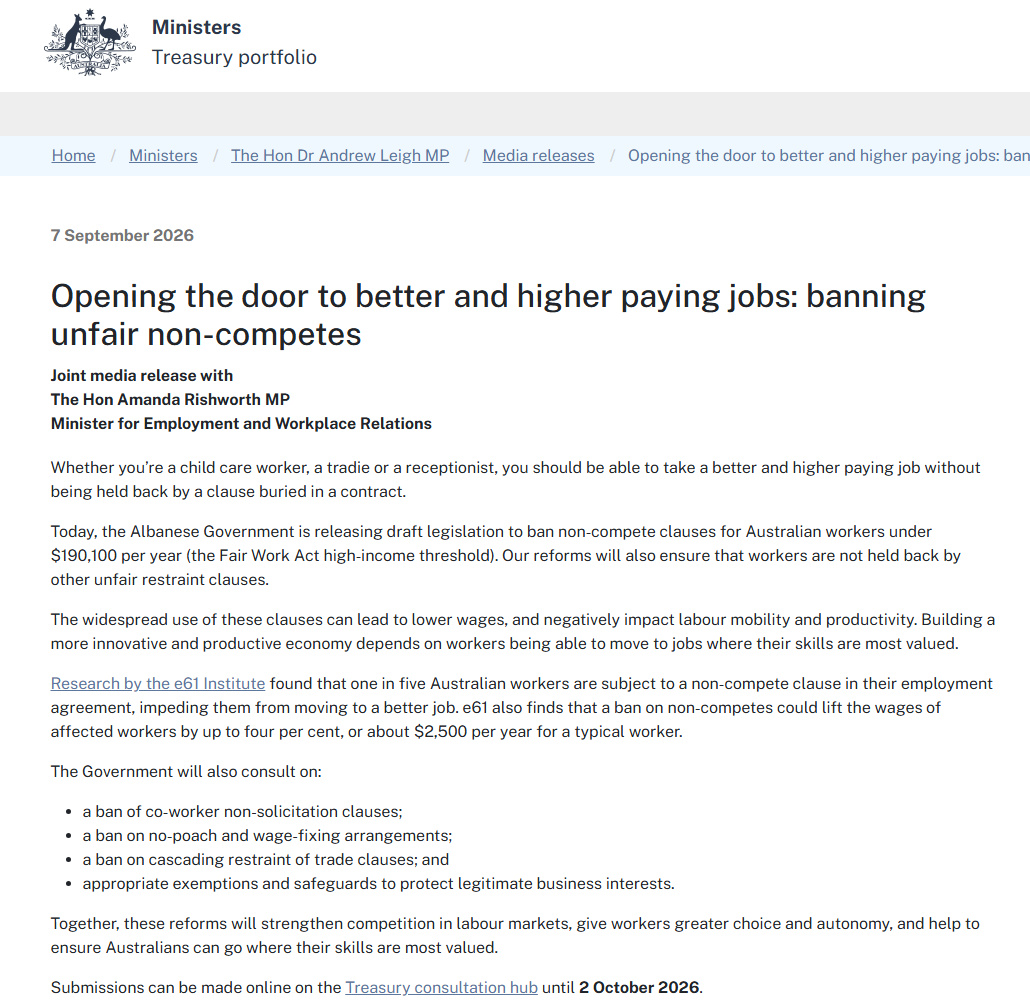
Joint media release of Assistant Minister Leigh and Minister Rishworth, 7 September 2026
03/When it would start
The draft sets commencement at the first 1 January, 1 April, 1 July or 1 October after Royal Assent. Penalties for writing a prohibited term into a contract start six months after commencement, and only for contracts made or varied after commencement; the penalty for threatening or enforcing a term that has lost effect starts on day one. As at 12 October this is still a consultation draft, and we found no record of a Bill introduced to Parliament. The Government's stated timing has been 2027.
One more point for NSW owners. The draft makes the Fair Work Act the exclusive law on post-employment restraints for national system employees, which displaces the NSW Restraints of Trade Act 1976 and its practice of letting a court cut an over-wide clause down to something reasonable. The old habit of drafting wide and letting the court trim will no longer work.
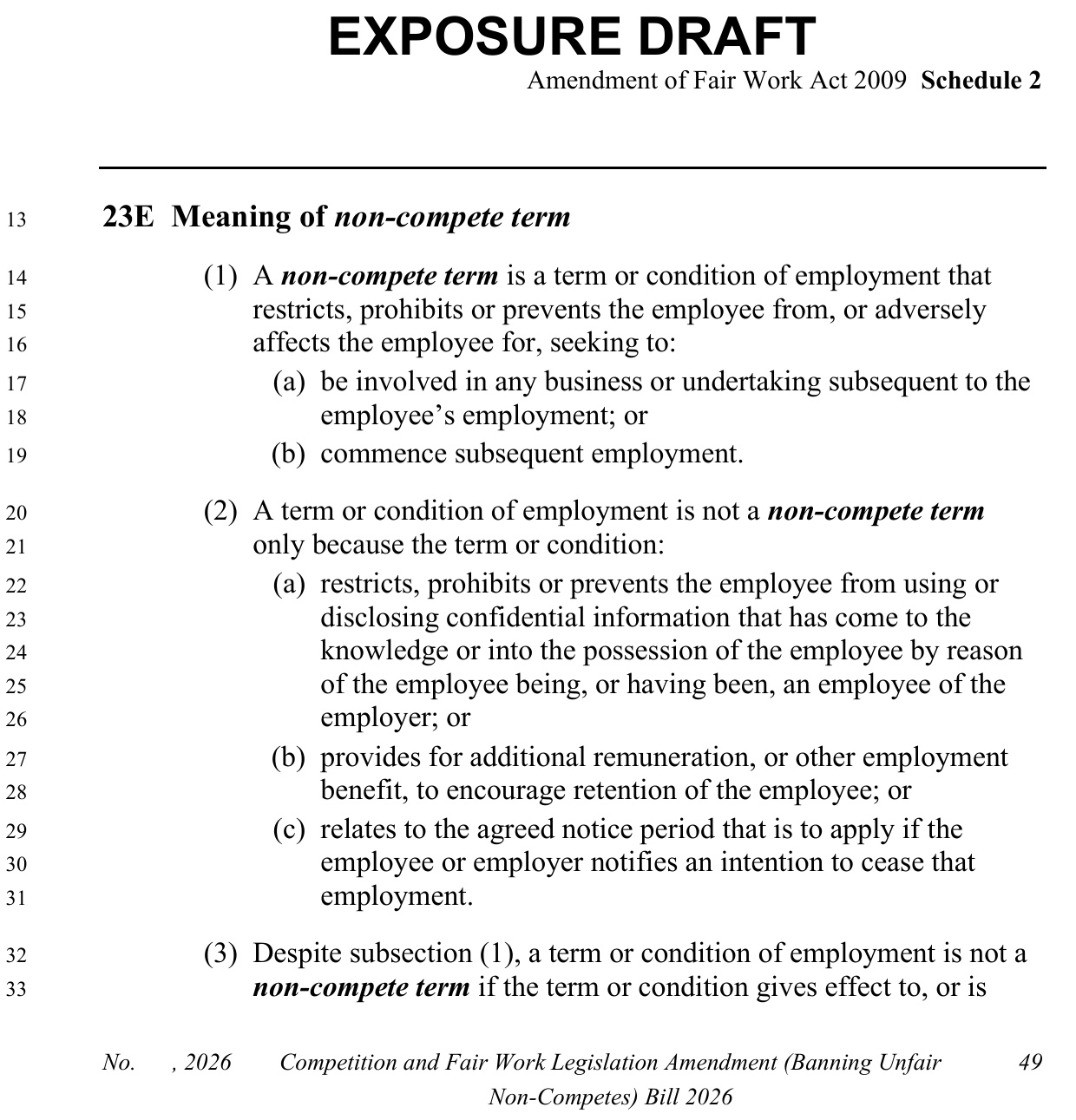
Exposure draft, section 23E: definition of a non-compete term
04/What an owner should do now
One: in new contracts, stop writing non-compete terms for staff under the threshold, and stop writing co-worker non-solicitation terms for anyone. There is no penalty before commencement, but there is one six months after it, and the clause was probably unenforceable anyway; all it buys you now is penalty exposure later.
Two: build the protections that will survive. Make the confidentiality clause specific: recipes, client lists, price lists, supplier lists, one by one. Draw the client non-solicitation clause narrowly, with a defined period and a defined set of clients. Set a proper notice period. The draft touches none of these.
Three: an existing contract keeps its terms if left alone, but do not lean on it. Even under current law a non-compete has to pass a reasonableness test, and for salon, restaurant or agency staff the courts rarely uphold one.
Four: any understanding with other operators not to hire each other's staff, or group chats comparing what to pay, should stop now. After commencement that is cartel conduct with criminal liability, and giving effect to a pre-commencement agreement after commencement is caught too.
If you are an employee: the draft is not a shield. Your current contract binds you until the law changes, so read it before you resign.
Keeping good people was never done
with a clause that stops them leaving.
The draft just writes that into law.

Sun Lawyers · Sydney Office
This article is current as at 12 October 2026; the draft is as published by Treasury, and the final law will be whatever Parliament passes. If you are an employer who wants the restraint clauses in your staff contracts to be both effective and compliant before the law lands, or an employee held back by a non-compete, contact Sun Lawyers. We work in both English and Mandarin.
Phone: 02 9267 4988 | Email: enquiry@sunlaws.com
Sydney Office: Suite 703 & 704, 265 Castlereagh Street, Sydney NSW 2000
Website: sunlaws.com.au
This article is general legal information only and is not legal advice.
Please contact us for advice specific to your situation.