
Six Black Friday Sale Claims
That Have Already Cost Retailers
This year the ACCC is also checking emails and social media
Black Friday is this Friday. The six retailers penalised so far all used very ordinary wording.
Every word on the sale sign is advertising | Source: Pexels
01/What the ACCC is checking this year
On 10 November the ACCC announced its third sweep of Black Friday and Cyber Monday advertising, across a range of retail sectors.
What is new is the reach. This year, for the first time, the ACCC is checking emails and social media alongside websites. A sale post on Instagram, WeChat or a marketing email is advertising in the same way a website banner is, and the same rules apply.
There are four targets. One, "sitewide" or "storewide" claims when many products are excluded. Two, time limited offers and countdown timers that keep running past the stated end. Three, pressure tactics such as misleading testimonials and false claims that stock is low. Four, sale prices compared with a reference price the item was never sold at, or was not sold at recently.
ACCC Deputy Chair Catriona Lowe put it this way: retailers who misrepresent the size, scope or duration of their sales risk ACCC action, such as an infringement notice or court proceedings.
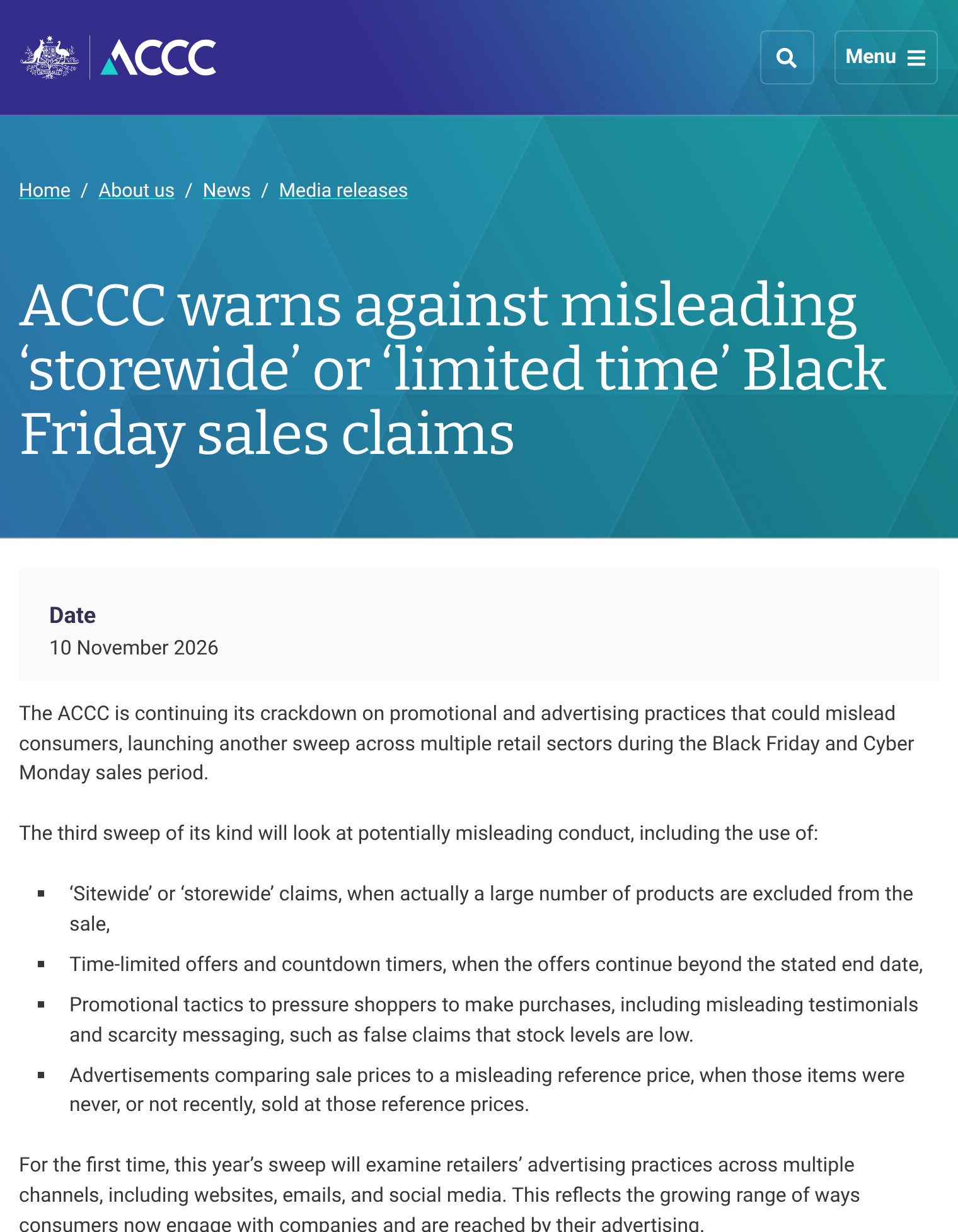
ACCC media release, 10 November 2026: warning against misleading "storewide" or "limited time" Black Friday sales claims
02/Six retailers, six kinds of wording
After the last two sweeps, six retailers paid penalties. None of the problems was complicated.
| Retailer | What the ad said | The problem | Penalty |
|---|---|---|---|
| Michael Hill jewellery | “Member Event 25% off Sitewide” | Some products were excluded and not discounted | $19,800 |
| MyHouse homewares | “Up to 60% Off Sitewide + EXTRA 20% off” | The extra 20% did not apply to every product | $19,800 |
| Hairhouse Online hair care | “SAVE 20% to 50% SITEWIDE” | More than a quarter of products were excluded | $19,800 |
| James Lane furniture | “Sale ends today!” with an end date of 3 December | The sale price ran another week, and the extension was decided before the sale began | $19,800 |
| Vuly trampolines | “up to 30% off” with a countdown timer | When the timer hit zero the offer became “up to 45% off” with a new timer; it reset again after Black Friday | $39,600 (two notices) |
| digiDirect electronics | $229 struck through, now $149, “price slashed” | The product was almost never sold at $229 | $99,000 (five notices) |
For a company, each infringement notice was $19,800 at the time. The six retailers received eleven notices between them, $217,800 in total.
The amount has since gone up. From 1 July 2026 an infringement notice is, in most cases, $21,840 for a company, $4,368 for an individual and $218,400 for a listed company.
An infringement notice is the light option. Court is a different scale. In April this year the Federal Court ordered mattress seller Emma Sleep to pay $15 million: all 74 of its products carried a struck through price, and 58 of them had never been sold at that price; its countdown timer reset itself during the campaign, and the page said "Ending Soon" while the same discount carried on. In 2023 Dell Australia was ordered to pay $10 million over struck through prices on monitors. The statutory maximum is higher still. For conduct on or after 28 March 2026, a company can be ordered to pay up to $100 million for each contravention. If the Court can work out the benefit the business gained, and three times that benefit is more than $100 million, the higher figure applies. If it cannot, the maximum is the greater of $100 million and 30% of turnover over the relevant period.
Two points of fairness. Paying an infringement notice is not an admission of a contravention, as the ACCC notes in its own releases. digiDirect is the exception: it also gave a court enforceable undertaking in which it admitted its discount claims were misleading and agreed to put a compliance program in place.
All six are chains or sizeable online stores. The law does not turn on size, though. A corner shop and an online store are under the same Act.
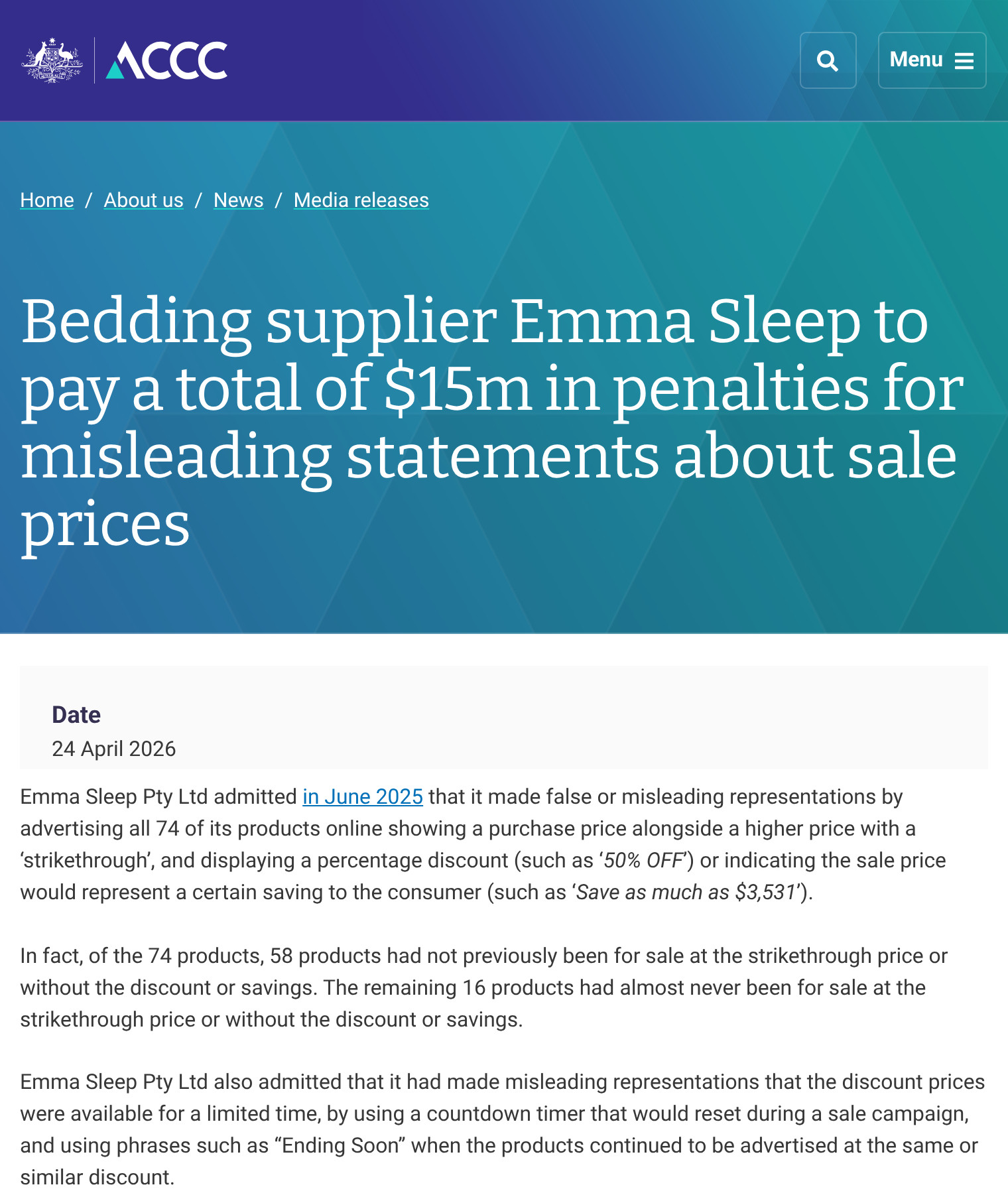
ACCC media release, 24 April 2026: Emma Sleep to pay $15m in penalties for misleading statements about sale prices
03/Three lines that are easy to cross
One: it counts even if you did not mean it. The ACCC's guidance says it makes no difference whether a business intends to mislead or not. What matters is the impression the ad leaves, not what the owner had in mind.
Two: fine print cannot rescue a headline. The ACCC's rule is that fine print and qualifications must not conflict with the overall message of the advertisement. A headline of "50% off everything" with an asterisk saying "exclusions apply" does not work.
Three: the "was" price has to be real. A struck through price must be one the item was actually sold at for a reasonable period right before the sale, and not for just a handful of sales. A promotion that runs too long has the same problem: the sale price becomes the normal price and can no longer be called a special.
How long is a reasonable period? The ACCC gives no number of days. The one case to look at is the Federal Court's decision against Coles on 14 May this year ([2026] FCA 598). The Court found that, for these packaged supermarket products, a "was" price that had been charged for less than 12 weeks would mislead shoppers when used for a discount comparison. Coles had charged the higher price for only about four weeks, and 13 of the 14 sample tickets were found misleading. The penalty is still to be decided. Note that 12 weeks is not a general rule. It was reached for this kind of supermarket product, with reference to Coles' own earlier internal guideline, so it cannot simply be carried over to every industry.
A word on "up to X% off". The wording itself is not unlawful, and plenty of stores use it. The ACCC has called out two situations: where the words "up to" are small and easy to miss, and where only a few products actually reach that discount.
04/Five checks before the ad goes out
One: if it says "sitewide", make it sitewide. If some products are out, say so in the headline, for example "selected items".
Two: if it gives an end date, end on that date. If an extension is already planned, do not write "last day".
Three: when a countdown timer reaches zero, the offer stops. Do not reset it.
Four: use a struck through price the item was recently and genuinely sold at, and keep the records: when it sold at that price, and how many.
Five: "only 3 left" and "5 people are viewing this" have to be true.
These five apply equally to websites, shopfronts, emails and social media. One step further ahead: from 1 July 2027 the new unfair trading practices law commences. Using page design to put unreasonable pressure on customers, or to get in their way, may also be unlawful where it causes or is likely to cause them harm.
A sale can be loud.
Every word of it still has to be true.
Sun Lawyers · Sydney Office
This article is current as at 24 November 2026 and is based on ACCC media releases and published guidance. If you run an online store or a shopfront, or regularly run group buys and seasonal promotions, and want your wording checked before it goes out, or have received a letter from the ACCC or Fair Trading, contact Sun Lawyers. We work in both English and Mandarin.
Phone: 02 9267 4988 | Email: enquiry@sunlaws.com
Sydney Office: Suite 703 & 704, 265 Castlereagh Street, Sydney NSW 2000
Website: sunlaws.com.au
This article is general legal information only and is not legal advice.
Please contact us for advice specific to your situation.