
From 28 November, Arriving on a Visitor Visa Means No Switching Visas Onshore:
Parents and Partners Are Affected
VISAS ALREADY GRANTED ARE NOT AFFECTED
Many people used to arrive on a visitor visa and apply for another visa once here.
With a visitor visa applied for from 28 November, that is no longer possible.
If you already hold a visa, check whether it carries condition 8503.
Arrive on a visitor visa, and the next visa starts offshore | Source: Pexels
01/What changed, in three points
One: the new rule starts on 28 November. It is in the Migration Amendment (Preventing Further Stay for Visitor Visas) Regulations 2026, registered on the Federal Register of Legislation on 13 November as F2026L01503.
Two: what used to be optional is now automatic. Condition 8503 is called No Further Stay. It means that while you are in Australia you cannot apply for another visa.
For the Visitor visa (subclass 600) in the Tourist and Business Visitor streams, the case officer used to decide whether to add it. Now it is always added. For the Electronic Travel Authority (601) and eVisitor (651), it could not be added before. Now it always is.
Frequent Traveller (ten year) visas, family sponsored visitor visas and Approved Destination Status group visas already carried 8503. Nothing changes for them.
Three: what counts is the day you apply. Applications made on or after 28 November come under the new rule. Applications made before 28 November stay under the old rules even if the visa is granted later, and visas already granted are not affected.
The old rules can still produce a visa with 8503: until now, adding it was up to the case officer.
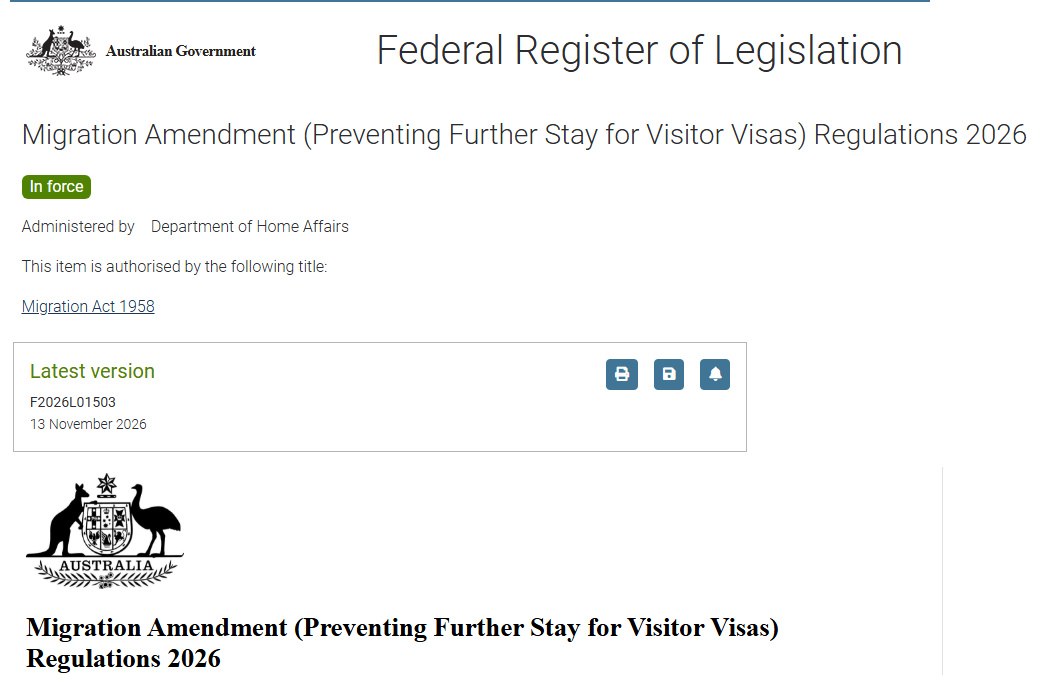
Federal Register of Legislation: Migration Amendment (Preventing Further Stay for Visitor Visas) Regulations 2026, F2026L01503, In force
02/What happens if your visa has 8503
While you are in Australia, you cannot apply for another visa. Lodging anyway does not help: the application is invalid, the Department will not assess it, and no bridging visa is given. When the visitor visa runs out, you have to leave. The basis is section 46(1A) of the Migration Act.
That covers student, partner, parent, employer sponsored and skilled visas. It also covers a second visitor visa applied for in Australia to stay a few more months. The exceptions in the Act are a protection visa and any temporary visa of a kind specified in the regulations, and the second is not a routine way out.
Two things are not affected. You can leave and apply for any visa from overseas, including another visitor visa. And you can enter, stay and depart as the visa allows. The explanatory statement says the change is not expected to have a material impact on genuine tourists.
03/The four groups most affected
One: parents visiting who want to stay longer. Until now they could apply in Australia for another visitor visa before the first ran out. With 8503 they cannot. They must leave when the visa ends and apply again from overseas.
Two: parents who want to stay and apply for an aged parent visa. Subclasses 804 and 864 must be applied for in Australia, and a visa with 8503 blocks that. Parent visas that can be lodged from overseas are not affected, though the queue and the cost are another matter.
Three: a partner who arrives on a visitor visa and then applies for a partner visa. With 8503, the onshore subclass 820 cannot be lodged. The choices are to apply offshore for the subclass 309, or to ask for a waiver first. Wanting to lodge a partner visa is generally not a reason for a waiver.
Four: employers who want someone to arrive on a visitor visa and get a work visa once here. That no longer works. The work visa has to be granted offshore before the person enters. A visitor visa does not allow work in any case.
Student visas are separate: since 2 October, visitor visa holders have already been unable to apply for a student visa in Australia. That has nothing to do with 8503.
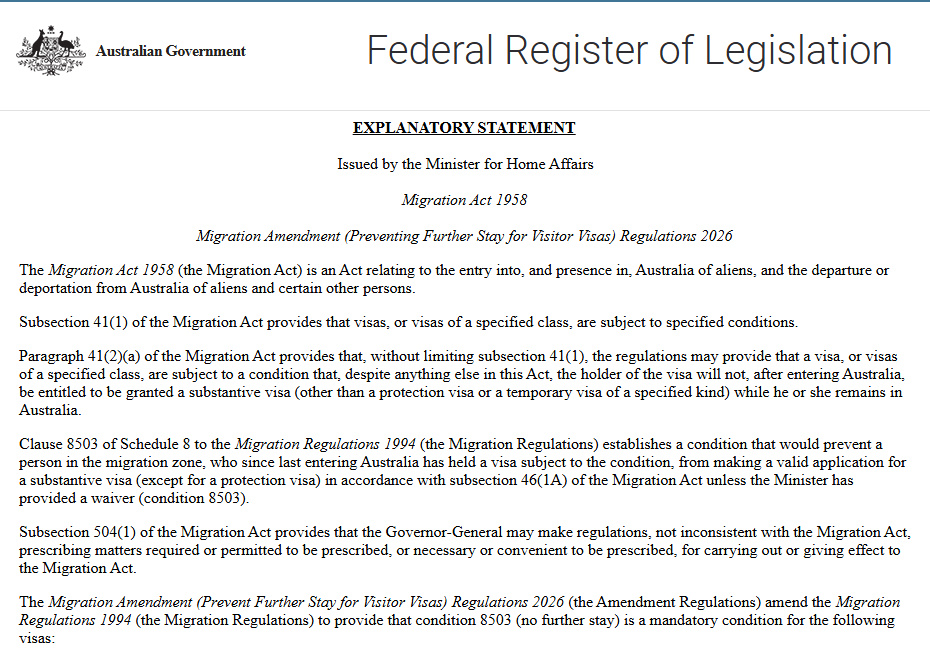
Explanatory statement: a person subject to 8503 cannot validly apply onshore for a substantive visa other than a protection visa unless the Minister waives the condition
04/What to do now
Check the visa you hold. Open the grant letter or log in to VEVO and look for 8503 in the conditions. If it is not there, the visa works as before and the new rule does not touch it.
This matters most if you hold a multi year, multiple entry visitor visa without 8503: do not reapply without a reason. An application made from 28 November will carry 8503.
If you are about to apply for a visitor visa for family. An application made on or before 27 November is decided under the old rules. Keep two things in mind. A case officer can still add 8503 under the old rules, so applying early is no guarantee. And a visitor visa is for people who will leave: if the application suggests the person plans to stay, it may be refused.
Do not count on a waiver. You can ask for 8503 to be waived, at no cost. The test is strict: after the visa was granted, something beyond your control must have happened that changed your situation in a major way, and the circumstances must be compelling and compassionate, such as sudden serious illness or a death in the family. There is also a narrow ground for a person who genuinely intends to apply for certain visas such as General Skilled Migration. A waiver is a remedy after something goes wrong, not a plan to enter on.
Why now. The explanatory statement gives two reasons: visitor visas should be used for short visits, and the government wants to reduce net overseas migration and stop people staying on by moving from one temporary visa to the next. It also records that no one outside government was consulted.
Three last things. First, check every family member's visa for 8503. Second, if the plan is to stay long term, whether as a parent, a partner or a sponsored worker, decide which visa and where to lodge it before travelling, not after arriving. Third, if you are already in Australia on a visa without 8503 and qualify for the visa you were preparing to apply for, 28 November makes no difference. Carry on as planned.
From here, a visitor visa is only a visitor visa.
The way to stay has to be chosen before the flight.

Sun Lawyers · Sydney Office
This article is current as at 23 November 2026 and is based on the Regulations and explanatory statement on the Federal Register of Legislation. Visa conditions and available pathways differ from person to person. If you or your family are planning a visit, a parent or partner application or employer sponsorship and want to confirm the conditions on a current visa and where the next application should be lodged, contact Sun Lawyers. We work in both English and Mandarin.
Phone: 02 9267 4988 | Email: enquiry@sunlaws.com
Sydney Office: Suite 703 & 704, 265 Castlereagh Street, Sydney NSW 2000
Website: sunlaws.com.au
This article is general legal information only and is not legal advice.
Please contact us for advice specific to your situation.