
Cancelling Can't Be Harder Than Signing Up:
New Rules for Subscription Businesses from July 2027
A TIKTOK PUT THIS LAW IN THE HEADLINES. GYMS, SALONS AND ONLINE SHOPS ARE ALL IN. CORPORATE PENALTIES UP TO $100 MILLION
Signing up takes 30 seconds. Cancelling means a trip to the counter in person.
From 1 July 2027 that is unlawful.
If you run memberships, charge monthly fees or add a "service fee" online, you have eight months to fix contracts and processes.

One tap to join, a trip to the counter to leave | Source: Pexels
01/One video, one Act
In June, a Melbourne woman named Stephanie moved house. Her Fernwood gym was now an extra hour each way, so she tried to cancel. Customer service told her the only way was to come in and sign in person. She reread the terms she had agreed to: they allowed cancellation by email or post. She asked again, was fobbed off, and only then was told she could cancel in writing with 28 days' notice. She put the story on TikTok, saying it felt easier to break out of prison than to cancel the membership. 370,000 people watched it, and many commenters shared the same experience.
When the press reported it on 16 June, Andrew Leigh, the Assistant Minister responsible for competition, said in a written statement that these were exactly the "tricky tactics" the government was legislating to stop. Treasury had been consulting on the law since 2023; the bill entered Parliament on 1 April, passed the House on 14 May, and was awaiting the Senate when the video went viral. It passed both Houses on 2 July. It commences on 1 July 2027, after a 12 month transition, and the ACCC has been given $67.7 million over four years to enforce it, with guidance due during the transition.
The Act amends the Australian Consumer Law in three ways: a general ban on unfair trading practices (new section 28B), a rule on charges that only appear at checkout (new section 48A), and a set of rules for subscription contracts (new sections 48B to 48H). Penalties follow the existing ACL maximums: for a company, the greater of $100 million, three times the benefit, or 30% of turnover; for an individual, $2.5 million. The $100 million figure was lifted from $50 million on 28 March 2026.
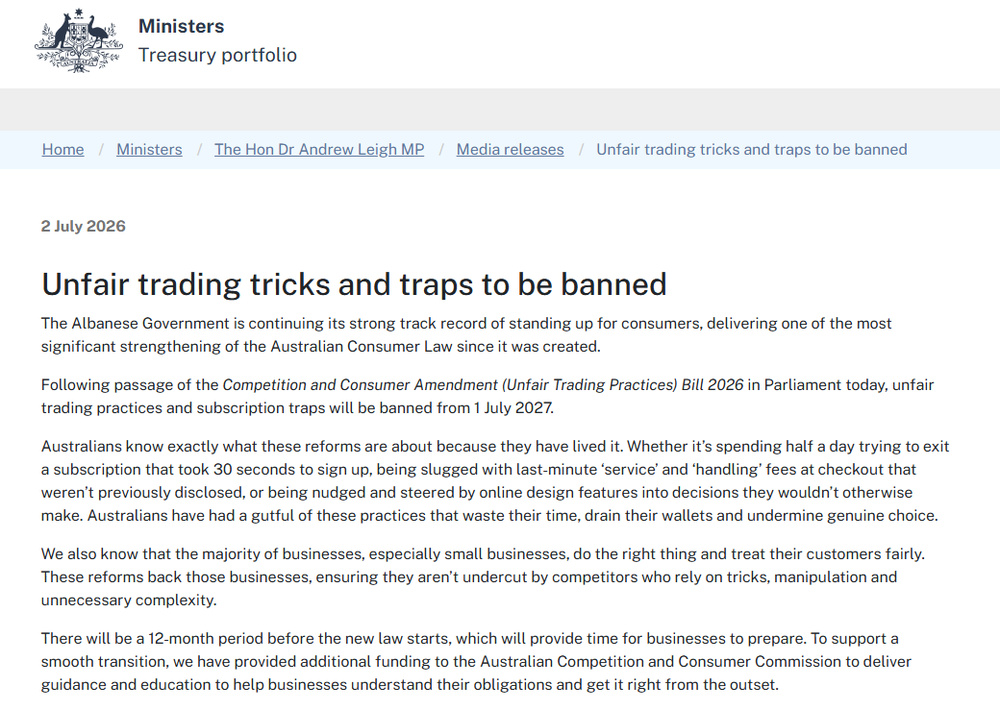
Assistant Minister Andrew Leigh, media release of 2 July 2026: unfair trading practices and subscription traps banned from 1 July 2027
02/If you sell memberships, three things change
First, who is covered. A gym or yoga studio on monthly direct debit, a salon monthly plan, an online course that rolls over, a meal or grocery box, a monthly parking pass: a contract that bills on an ongoing basis, renews automatically, or starts charging when a free trial or promotional period ends is, as a rule, a subscription contract under the Act. Leases, instalment contracts and some education and childcare contracts are excluded; the full list depends on the regulations. A prepaid ten visit pack that does not renew is generally outside the subscription rules, though the general ban in section 04 still applies.
One, disclose before they sign. That it is a subscription, whether it is fixed or open ended, what it costs, when it renews, how much notice cancellation needs and how to cancel. Online, that information has to sit near the point where the customer agrees, legibly and prominently; by phone or in person, it has to be said clearly before the customer agrees.
Two, remind them along the way. At key points the same information has to go out again: before a free trial converts to paid, before a fixed term rolls over, and periodically on an open ended contract. How many days in advance and how often will be set by regulation; the framework in the bill was six monthly for open ended contracts, but the regulations will govern.
Three, make cancelling easy to find and easy to do. The cancellation method must be easy to locate, straightforward, and require only steps that are reasonably necessary. If a customer can sign up online, they must be able to cancel online. The explanatory material gives the Fernwood scenario as its example: requiring a customer who has moved interstate or overseas to attend in person is unlikely to be reasonably necessary.
Two last points. First, timing: the subscription rules apply to contracts entered into on or after 1 July 2027, and to earlier contracts that are renewed, extended or varied after that date. Second, the protection runs both ways: your own monthly contracts for POS software, booking systems or delivery platforms are covered too, where the contract is the provider's standard form and your business has fewer than 100 employees or turnover under $10 million.
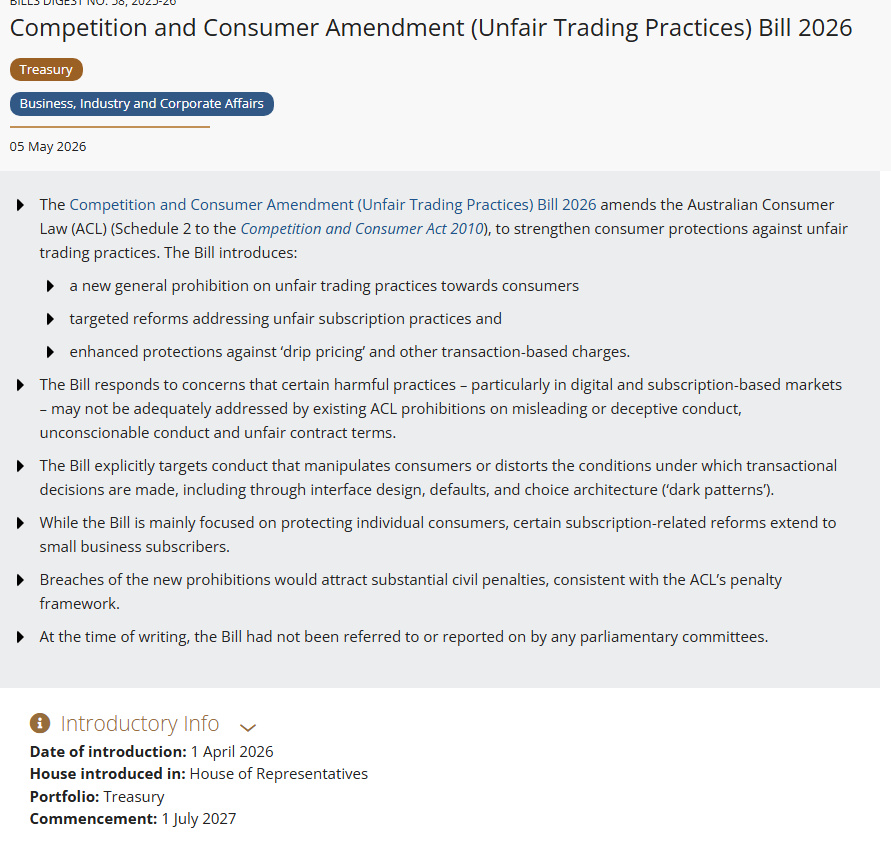
Parliamentary Library Bills Digest: new section 28B general ban, section 48A transaction charges, sections 48B to 48H subscription contracts, commencing 1 July 2027
03/If you charge a "service fee" online, one more rule
Section 48A is about the small print beside the price. Wherever you display a price, any charge the customer must pay that is calculated per transaction, such as an ordering platform service fee, a booking fee or a handling fee, has to be shown at the same time: the amount if it can be worked out, otherwise the method; whether it applies to every transaction; and whether the displayed price includes it. It has to sit next to the price, legibly and prominently, all the way through the checkout.
Optional charges and taxes are outside the rule, and so are card surcharges, which have in any case been banned since 1 October. The rule is mainly about goods and services for personal and household use; offers made solely to corporate customers are outside it. One point from our last article is worth repeating: renaming a surcharge as a "service fee" is something the ACCC has already said may be misleading. From July next year, even a legitimate service fee is unlawful if it is not shown beside the price.
04/The new law is not in force yet. The old law is
The new Act starts next July, but the Fernwood approach is not unregulated today. Telling a customer they can only cancel in person when the contract says email is fine is a misleading representation about their rights, and may breach section 18 of the Australian Consumer Law as it stands. An oppressive cancellation term in a standard form contract, say 90 days' notice or registered post only, may be an unfair contract term, and since 9 November 2023 simply including such a term can attract a penalty. The ACCC is already using the existing law on this kind of conduct: in December last year it took HelloFresh and Youfoodz to the Federal Court, alleging that sign up was easy online but the first delivery could only be cancelled by phoning customer service, and that 62,061 and 39,408 customers respectively were charged despite cancelling before the cut off. No judgment had been delivered at the time of writing.
Then the new general ban. The test has two limbs and both must be met: conduct that manipulates the consumer, or unreasonably distorts the environment in which they decide; and detriment, actual or likely, which is not limited to money and includes wasted time and reduced choice. The examples listed in the Act are impeding a consumer from exercising legal rights or seeking a refund, failing to disclose material information, presenting material information in a complex or unclear way, and using interface design to pressure or obstruct. It protects individual consumers only, not corporate customers or purchases made for a business.
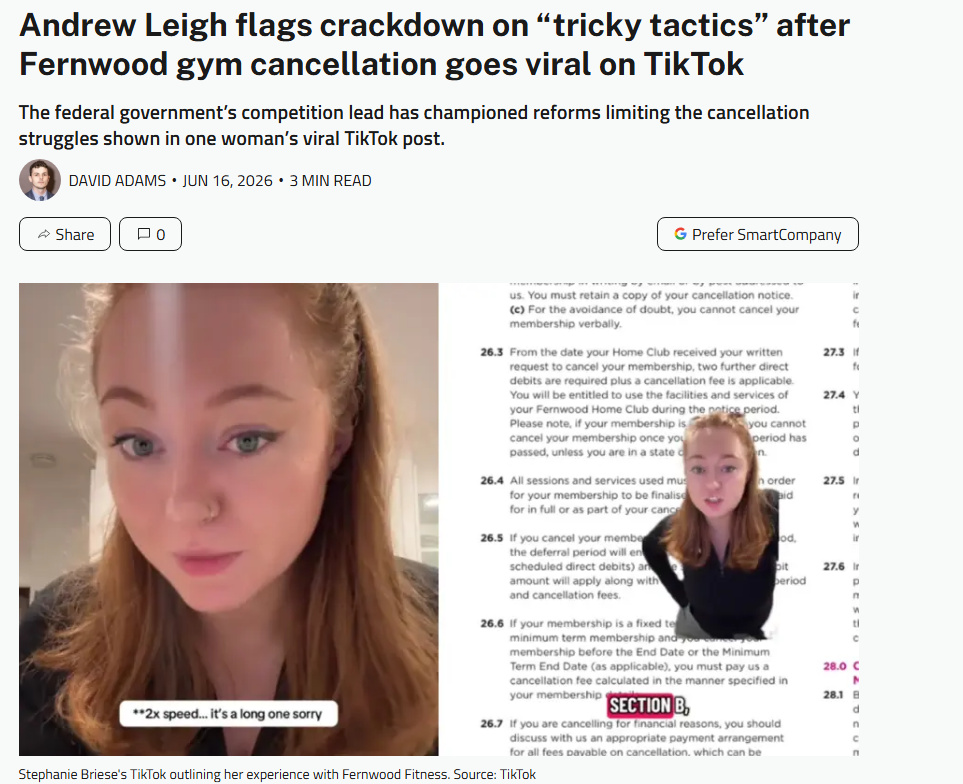
SmartCompany, 16 June 2026: after the Fernwood cancellation video went viral, the Assistant Minister named the "tricky tactics"
Four things to finish before July. First, pull out your membership contract and sign up page and check three points: disclosed before signing, reminded during the term, and cancellation as easy as joining. Second, if customers can join online, build online cancellation, and write it into staff scripts: nobody tells a customer they can only cancel in store. Third, on online ordering and booking pages, move every mandatory fee next to the price. Fourth, read the auto renewal and cancellation terms in your own software and platform contracts; from next year you are a protected party too.
Thirty seconds to join, half a day to leave.
From July next year, that is not poor service. It is unlawful.

Sun Lawyers · Sydney Office
This article is current as at 23 October 2026 and is based on the Act as passed by Parliament, the explanatory material and the Treasury ministers' media release; the regulations have not yet been published. If you run a gym, salon, education business, online shop or any membership or subscription model and want your contracts, sign up and cancellation processes made compliant before July 2027, contact Sun Lawyers. We work in both English and Mandarin.
Phone: 02 9267 4988 | Email: enquiry@sunlaws.com
Sydney Office: Suite 703 & 704, 265 Castlereagh Street, Sydney NSW 2000
Website: sunlaws.com.au
This article is general legal information only and is not legal advice.
Please contact us for advice specific to your situation.