
Pay Tables, Records, Super:
Three Things Every Business Owner Should Check This Year
UNDERPAYMENT IS NOW A CRIMINAL OFFENCE, AND SUPER IS PAID WITH WAGES FROM 1 JULY
The Ombudsman recovered $453 million last year. Eight in ten food businesses in a surprise sweep failed.
Most of what inspectors find is not theft. It is the wrong pay table and missing records.
This piece is not about what staff are owed. It is about how an owner keeps the risk outside the door.

The books in the kitchen have to add up like the ones at the till | Source: Pexels
01/Your odds of an inspection are higher than you think
On 14 September the Fair Work Ombudsman published its 2025-26 figures: $453 million recovered for 181,000 workers, up 27% on the year before. For an owner the number means one thing: inspections are unannounced and do not wait for a complaint. A surprise sweep in Hobart, reported on 4 August, covered 28 fast food outlets, restaurants and cafés; 22 of them, 79%, were non-compliant. The most common failures were not theft: the wrong base rate (20 businesses) and unpaid penalty rates (18). In other words, most of the owners caught did not think they were underpaying anyone. The Ombudsman's words: the fast food, restaurant and café sector "remains a national priority".
Then what happened to one Sydney owner. In February the Ombudsman sued the former part-owner and manager of a Japanese restaurant, alleging he was involved in underpaying 82 workers by more than $162,000: flat rates of $19 to $27 an hour, no overtime, no penalty rates, no annual leave. The company has been deregistered. The defendant is the man himself. Section 550 of the Fair Work Act treats anyone involved in a contravention as having committed it. Two things to take from that: closing the company is not an exit, and staff on visas are no guarantee that nothing will surface, because inspections do not depend on staff coming forward.
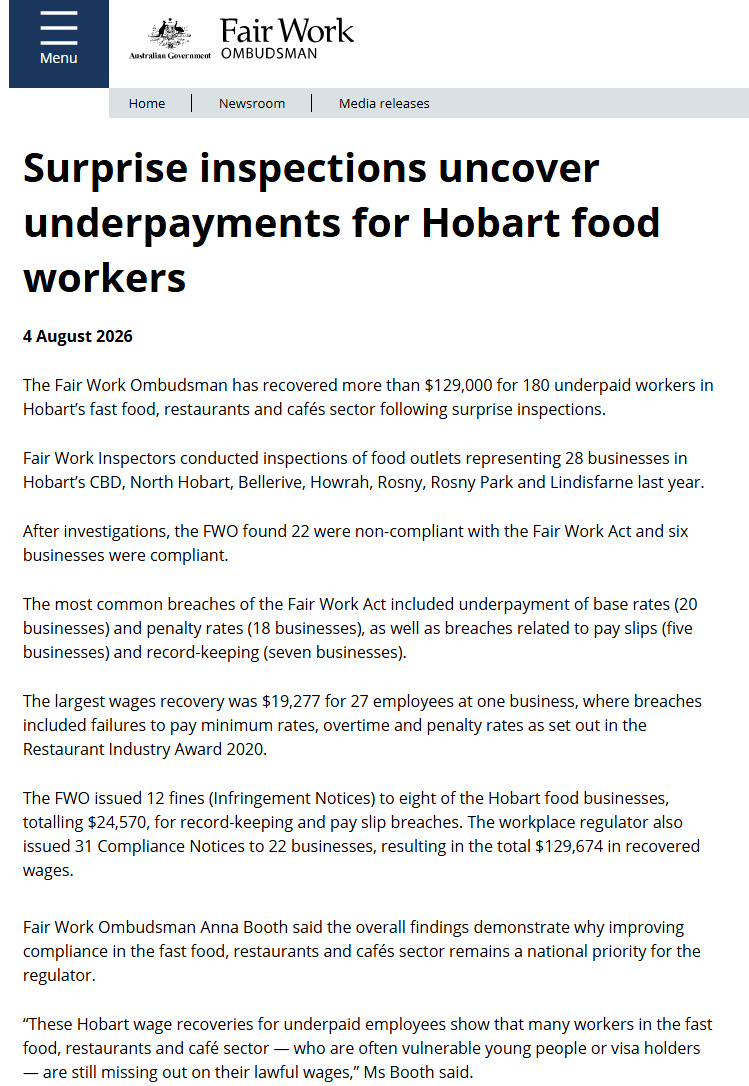
Fair Work Ombudsman, 4 August 2026: 22 of 28 Hobart food businesses inspected without notice were non-compliant
02/Line one: the flat hourly rate is the biggest trap
From 1 July 2026 the national minimum wage and every modern award rose by 4.75%; the floor is now $26.44 an hour. Restaurants, hair and beauty, and the building trades each have their own award, and an award sets more than the hourly rate: the 25% casual loading, evening, weekend and public holiday penalty rates, overtime, and allowances such as the split shift allowance. Paying everyone one flat rate is the most common way the businesses in those cases broke the law, and bank transfer or cash makes no difference.
Two mistakes owners make most often. First, a worker agreeing to less than the award changes nothing; the award is a floor, a private arrangement below it is void, and the worker can still claim the difference later. Second, paying someone on an ABN as a contractor does not necessarily get you out either. Since 2024 the law looks at the real substance of the relationship, and a person you roster, who uses your equipment and is paid by the hour, will usually be found to be an employee.
Cash is not illegal. Having no records is. Wage records must be kept for seven years and pay slips given within one working day of payday. What section 557C of the Fair Work Act means for an owner is this: if you did not keep the required records and have no reasonable excuse, the court presumes the worker's underpayment claim is correct unless you can disprove it. Records are not a burden. They are your only defence.
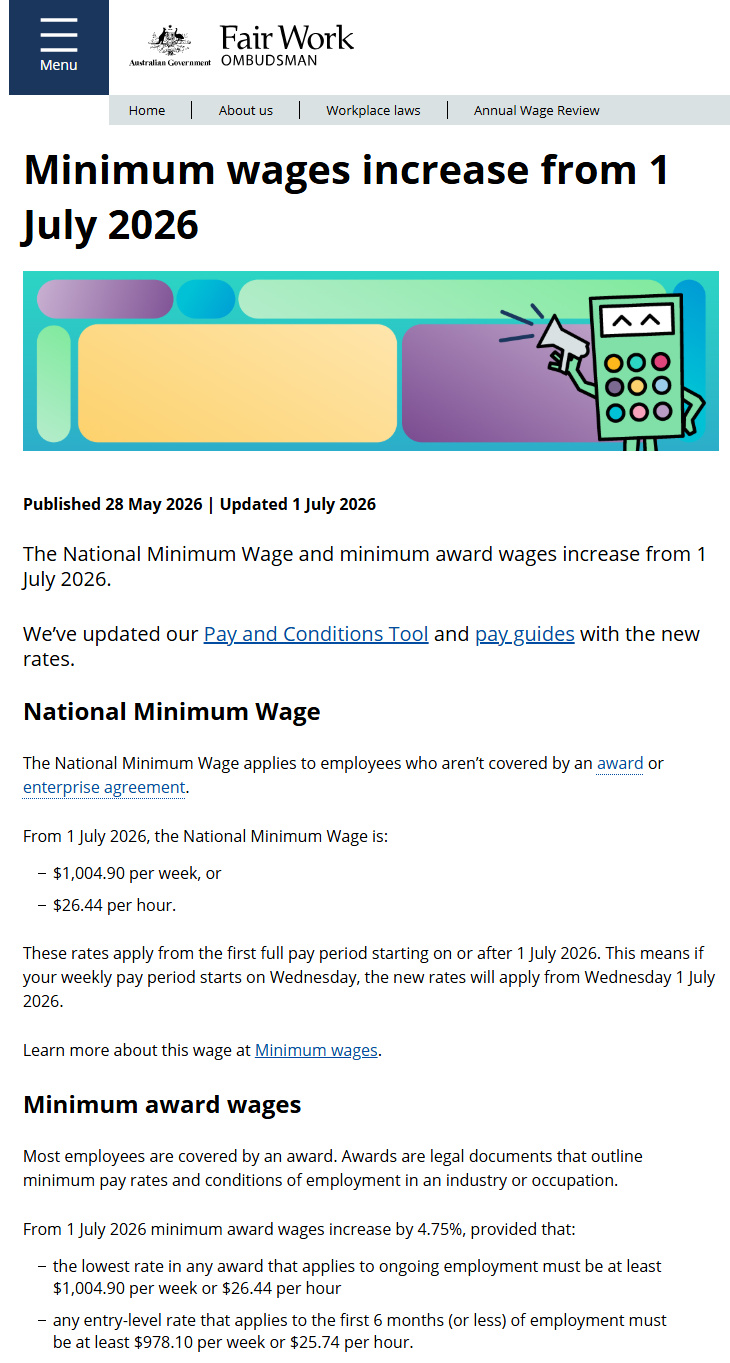
Fair Work Ombudsman: minimum wages increase from 1 July 2026, national minimum wage $26.44 an hour
03/Line two: when it is a crime, and when it is not
Since 1 January 2025, intentionally underpaying wages or superannuation has been a Commonwealth criminal offence (section 327A of the Fair Work Act). For an individual the maximum is 10 years' imprisonment and a fine of the greater of three times the underpayment or 5,000 penalty units; for a company, the greater of three times the underpayment or 25,000 penalty units. A penalty unit has been $364 since 1 July 2026, so the ceilings are $1.82 million for an individual and $9.1 million for a company. The Ombudsman investigates and refers cases to the Commonwealth Director of Public Prosecutions or the Australian Federal Police.
The operative word is intentional. A miscalculation, last year's pay table or not knowing an award applied is not a crime, though civil penalties and back pay still follow. Owners have two safe harbours. A small business with fewer than 15 employees whose underpayment was not intentional, and which made reasonable efforts under the Voluntary Small Business Wage Compliance Code, such as checking the award and asking the Ombudsman or an industry association, will not be referred for prosecution. An owner who finds an underpayment and discloses it to the Ombudsman can enter a cooperation agreement, which also rules out referral. Both require you to check first, rather than wait for an inspector. If you receive a Compliance Notice, back-pay by the deadline and confirm it in writing; if you dispute it, apply promptly for court review, because there is a time limit. The worst response is to ignore it. Ignoring a notice is a contravention in itself.
04/Line three: super now has seven business days
Payday Super started on 1 July 2026. Every time you pay wages, the super must reach the employee's fund within seven business days. Reach the fund, not leave your account. Quarterly payment is over, and the ATO's Small Business Superannuation Clearing House closed on 1 July. Super paid after the deadline can attract the Superannuation Guarantee Charge (SGC), which covers the unpaid amount, interest and an administrative uplift. An employer should not assume the ATO will sort out every late payment on its own; if a payment is late or missed, check it promptly and meet whatever reporting and catch-up obligations apply. For an owner there is one change to make: connect super to the pay run, so that every pay triggers a super payment.
The ATO has been clear about the first year. Employers who pay every payday and fix errors promptly are not the focus of compliance action; employers who do not pay on payday at all, or who deliberately withhold, will be dealt with firmly. Note also that, within the scope the law sets, deliberately failing to pay super can carry criminal liability as well.
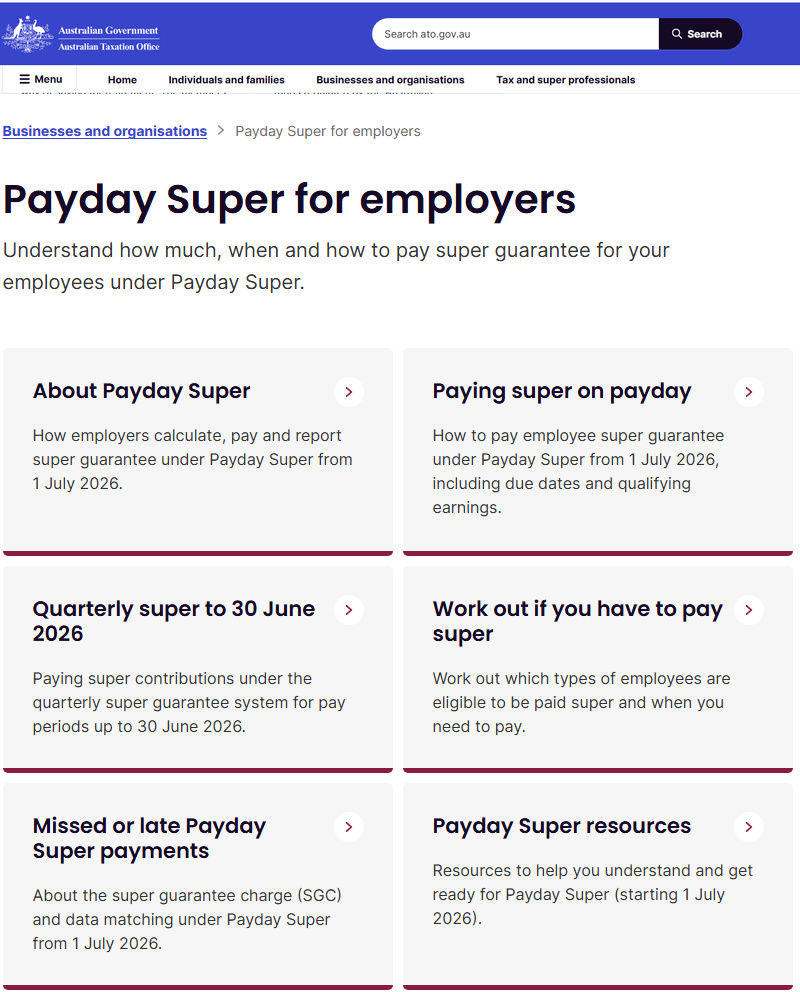
Australian Taxation Office: Payday Super from 1 July 2026
Three steps you can take this week. Step one, audit: run every employee's rate through the Ombudsman's Pay and Conditions Tool against your award, replace flat rates with award rates, and look hard at anyone on an ABN. Step two, records: check your wage and time records for the past seven years, and where anything is missing, look into it and deal with it promptly. Step three, super: have your accountant or payroll software attach super to each pay run, with the seven business days counted from payday. If the audit turns up an underpayment, fix it first, then decide whether to disclose it. That decision is worth a lawyer's eye, because how you disclose determines which safe harbour you land in.
An owner controls only three things:
whether the pay table is this year's, whether the records exist, and whether the super has landed.
With those three in hand, an inspector at the door is not a crisis.

Sun Lawyers · Sydney Office
This article is current as at 12 October 2026; figures are as published by the Fair Work Ombudsman, the Fair Work Commission and the Australian Taxation Office. If you run a restaurant, salon, trade business or any other business with staff and want wages, records and super sorted in one pass, have found an underpayment and want to know how to handle it, or have already received a notice from the Ombudsman, contact Sun Lawyers. We work in both English and Mandarin.
Phone: 02 9267 4988 | Email: enquiry@sunlaws.com
Sydney Office: Suite 703 & 704, 265 Castlereagh Street, Sydney NSW 2000
Website: sunlaws.com.au
This article is general legal information only and is not legal advice.
Please contact us for advice specific to your situation.